12 Questions to Ask a Cosmetics Manufacturer Before You Commit
The short answer: Ask about regulatory support for your target markets first, then certifications, formula ownership, realistic MOQs and lead times, and who you will actually deal with day to day. Price and unit cost are the last things to compare, not the first. Hong Shin, established 2012, serves customers in 16 countries with ISO 22716, ISO 9001, SEDEX, BSCI, and US FDA facility registration.
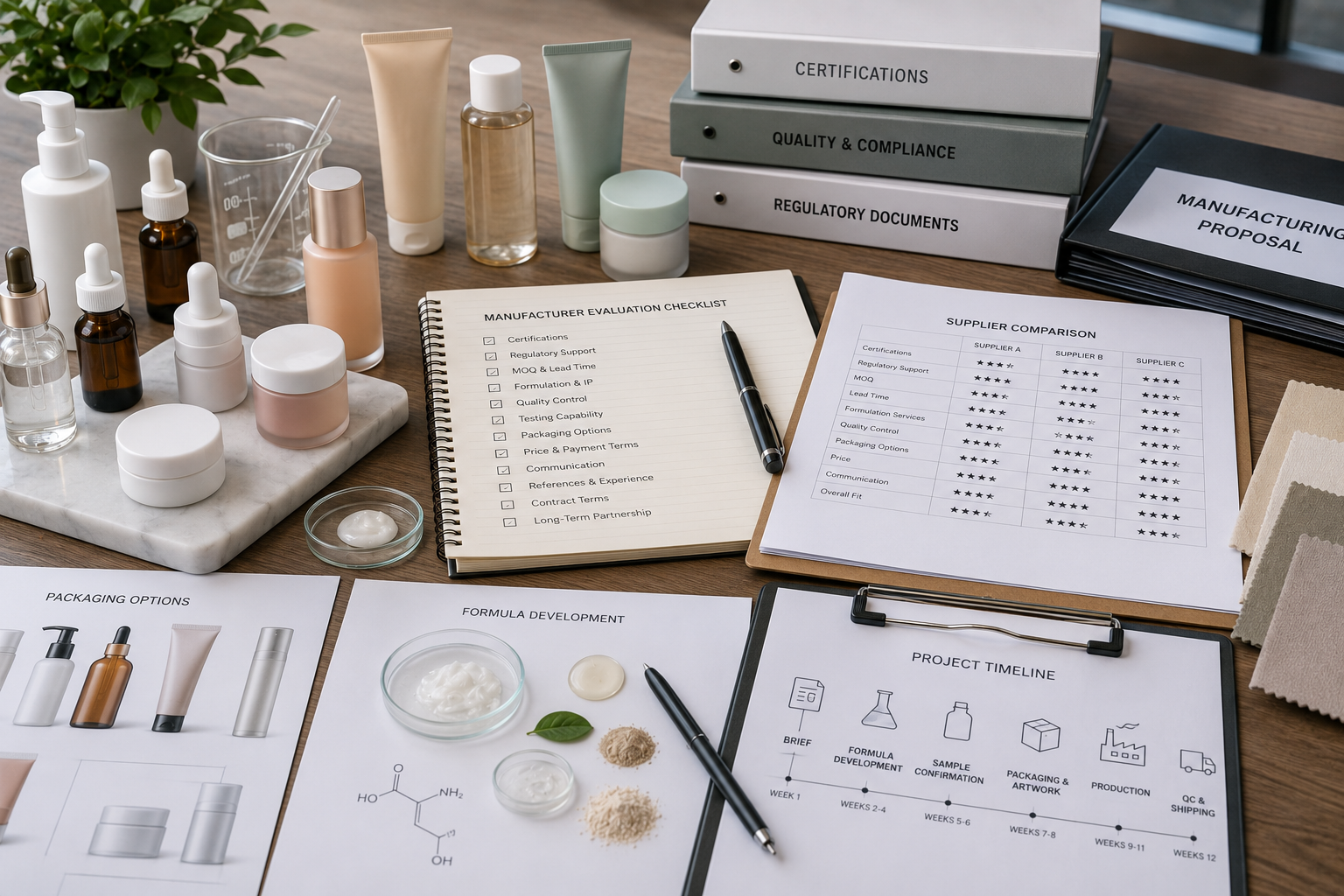
Choosing a production partner is the decision that quietly shapes everything that follows, from your launch date to your margins to whether your product clears customs at all. This guide walks through the 12 questions to ask a cosmetics manufacturer before you sign anything, so you can compare partners on the things that actually matter for a serious launch rather than on price alone. Each question comes with what a strong answer sounds like and why it matters.
Why the right questions matter more than the lowest quote
The lowest MOQ and the lowest unit price are easy to shop for, and they are usually the wrong anchors. A first run that ships late, fails a regulatory notification, or arrives with a formula that separates on the shelf costs far more than the few cents you saved per unit. The right questions to ask a cosmetics manufacturer are the ones that surface hidden risk early: regulatory capability, certification depth, formulation ownership, and realistic timelines.
Hong Shin Cosmetics is a contract manufacturer established in 2012, with 13 years of operation and customers in 16 countries, manufacturing in both Taiwan and South Korea. We are not the lowest-MOQ option on the market, and we say so plainly. The questions below reflect how we think a serious buyer should evaluate any partner, including us.
1. Where is the product actually made?
Origin affects quality, lead time, regulatory paperwork, and the story you can honestly tell on your label. Ask whether the manufacturer owns its production or brokers it out to a third party, because a broker adds a layer of cost and a layer of distance from quality control.
Hong Shin manufactures in Taiwan and South Korea, both genuine in-house capabilities rather than a single site with outsourced overflow. The South Korea capability is what gives buyers direct access to K-beauty formulation, including actives like PDRN, peptides, niacinamide, bakuchiol, vitamin C, hyaluronic acid, centella, ceramides, and AHA/BHA. If a manufacturer is vague about where a given formula is produced, treat that as a flag. See the full product range on our offerings page.
2. What certifications do you hold, and can you show them?
Certifications are the closest thing to objective proof in a market full of claims. Ask for the specific standards, not a general assurance of quality, and ask to see current certificates.
The certifications that matter most for cosmetics are:
| Certification | What it covers |
|---|---|
| ISO 22716 | Cosmetic Good Manufacturing Practice (GMP) |
| ISO 9001 | Quality management systems |
| SEDEX / BSCI | Ethical and social compliance auditing |
| US FDA facility registration | Registered manufacturing facility |
Hong Shin holds all of the above. Note the precise language on FDA: a facility is FDA-registered. The FDA does not approve cosmetics, it registers facilities and regulates OTC drug products. Any partner that claims to be "FDA-approved" for a cosmetic is either careless or misleading, and you can read more on our certifications page.
3. Can you support the regulatory pathways for my target markets?
This is the question that separates a factory from a launch partner. Selling into Canada, the US, the EU, or the UK each carries its own notification or registration requirements, and getting them wrong delays or blocks your launch.
Ask which markets the manufacturer can actively support. Hong Shin provides regulatory support for:
- Health Canada NPN and cosmetic notification
- US FDA OTC and 25(b) pathways
- EU CPNP notification
- UKCA
If you are selling sunscreen, mosquito repellent, or anything that crosses from cosmetic into OTC drug territory, this support is not optional. Our compliance page covers how we handle these pathways in more detail.
4. What is your real MOQ, including reorders?
Minimum order quantity is where a lot of buyers get surprised. Ask for the first-run MOQ, the reorder MOQ, and the bulk option separately, because they are often very different numbers.
Hong Shin's indicative figures:
- Retail bottles, tubes, and jars: from 1,000 units per SKU on the first run
- Reorders: from 500 units per SKU
- Bulk semi-finished product: from 50 kg per formula
We also offer sachet sampling and kit assembly for low-commitment first projects, which lets you test a formula and a market before you commit to a full retail run. If a manufacturer quotes one MOQ and stays quiet on reorders, ask the follow-up.
5. How long is the lead time, and from what milestone?
"Lead time" is meaningless without a starting point. Ask whether the clock starts at the brief, at the quote, or at formula sign-off, because those are weeks apart.
Hong Shin works to roughly 10 to 12 weeks from formula sign-off to finished goods. That window assumes the formula is locked. Sampling and revisions happen before it starts. A realistic partner will give you a range tied to a clear milestone rather than a single optimistic number.
6. Do you offer custom formulation, or only stock formulas?
There is a real difference between private label (your brand on an existing, proven formula) and OEM/ODM (a formula developed for you). Both are legitimate. The wrong question is assuming a manufacturer does both well.
Hong Shin offers:
- Private Label: your brand on established formulas, the fastest route to market
- OEM/ODM: custom formulation with in-house R&D, including IP-exclusive formulas that belong to you
Ask specifically whether a custom formula is exclusive to you or shared across the manufacturer's clients. Exclusivity matters if your formula is part of your competitive position.
7. What can you actually formulate?
A manufacturer's category range tells you whether it can grow with you. Ask for the full list of product types, not just the one you are launching with.
Hong Shin's range spans:
- Full skincare: cleansers, cleansing balms, toners and essences, serums and ampoules, moisturizers and creams, eye care, face oils
- Masks: sheet, wash-off, clay, enzyme, and hydrogel
- Sun care and SPF, mists, and body care including lotions, mists, scrubs, and oils
- Sun care with mosquito repellent (25(b) exempt plus PMD and OLE)
- Pet wellness: mousse, sprays, and balms
If you plan a line rather than a single hero product, confirm the partner can produce the adjacent categories before you commit to the first one. Our ingredients page details the active formulation library.
8. Who owns the formula and the intellectual property?
This question is easy to skip and expensive to get wrong. Ask in writing who owns a custom formula after it is developed, and whether the manufacturer can sell a near-identical version to a competitor.
With Hong Shin's OEM/ODM service, IP-exclusive formulation means the formula developed for you is yours. Get the ownership terms documented in the agreement, not just discussed on a call.
9. What does the process look like from first contact to scale?
A clear process is a sign of an organized operation. Ask the manufacturer to describe its stages and what is expected of you at each one.
Hong Shin's process runs:
- Brief and NDA
- Quote and spec, returned within 5 business days
- Sampling
- Pilot run
- Ship and scale
The 5 business day quote turnaround is a concrete commitment you can hold a partner to. If a manufacturer cannot describe its process in clear stages, expect surprises later.
10. What are the payment and shipping terms?
Payment structure tells you how the partner manages risk and cash flow, and it affects yours too. Ask for deposit terms and the incoterms on offer.
Hong Shin works on 50% deposit and 50% before shipment, with FOB Taiwan or DDP available. FOB means you take responsibility once goods are loaded; DDP means delivered duty paid, which simplifies logistics if you would rather the manufacturer handle the freight and import. Choose based on how much logistics you want to own.
11. How do you handle stability, quality control, and documentation?
A formula that performs in a sample but separates after three months on a warm shelf is a recall waiting to happen. Ask how stability is tested and what batch documentation you receive.
Operating under ISO 22716 cosmetic GMP and ISO 9001, Hong Shin builds quality control and documentation into the process rather than treating it as an afterthought. Ask any manufacturer for the documentation it provides per batch, and confirm it matches what your target markets require for notification and audit.
12. Who is my point of contact, and in what language?
A great factory with poor communication will still cost you sleep. Ask who you will actually deal with, in what time zone, and in what language.
Hong Shin runs English-language project management from its HQ in Taipei, alongside Taiwan and South Korea manufacturing. For a North American or European brand, that combination removes a lot of the friction that comes with managing overseas production at a distance.
Frequently asked questions
What is the most important question to ask a cosmetics manufacturer first?
Start with regulatory capability for your target markets. A manufacturer can have excellent formulas and still leave you unable to legally sell, so confirm it supports your pathways (Health Canada NPN, US FDA OTC and 25(b), EU CPNP, or UKCA) before you go deep on product.
What is a typical minimum order quantity for a custom cosmetic?
It varies widely. Hong Shin's indicative MOQ is from 1,000 units per SKU on a first retail run, from 500 on reorders, and from 50 kg per formula for bulk semi-finished product. Sachet sampling is available for lower-commitment first projects.
How long does it take to get a cosmetic product manufactured?
Plan for roughly 10 to 12 weeks from formula sign-off to finished goods, with sampling and revisions happening before that window begins. Always confirm which milestone a quoted lead time is measured from.
What is the difference between private label and OEM/ODM?
Private label puts your brand on an established, proven formula and is the fastest route to market. OEM/ODM develops a custom formula for you, often IP-exclusive, with more control and more development time.
Does the FDA approve cosmetics?
No. The FDA registers manufacturing facilities and regulates OTC drug products, but it does not approve cosmetics. A trustworthy partner will describe itself as having an FDA-registered facility, never as FDA-approved for a cosmetic.
Work with Hong Shin
If you are weighing manufacturers, bring these 12 questions to the conversation and see how the answers compare. Hong Shin Cosmetics is the regulatory-capable, certified custom manufacturer that handles the compliance and quality control a serious launch needs, with genuine K-beauty formulation access through our South Korea capability. Request a quote through our contact page, and explore our OEM/ODM service to see how custom formulation works from brief to scale.