OEM vs ODM vs Private Label: Which Cosmetics Manufacturing Model Fits You
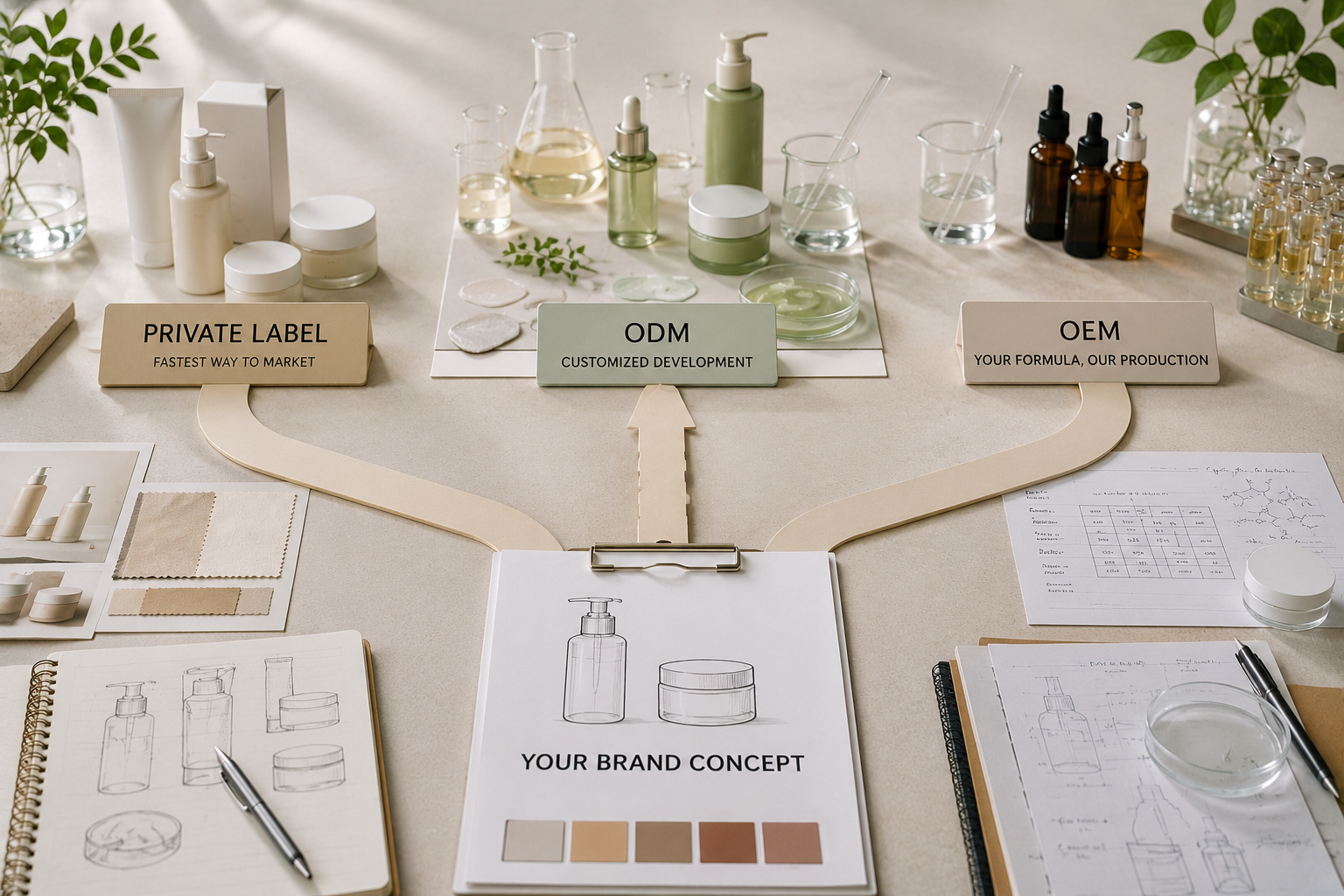
The short answer: Private label is fastest and cheapest -- use it to test a market. ODM is the right fit for a first custom line, especially with K-beauty actives. OEM suits brands that already own a tested formula. All three are available through Hong Shin, established 2012, with customers in 16 countries.
If you are planning a beauty line, one of the first decisions you face is the manufacturing model. This guide breaks down OEM vs ODM cosmetics alongside private label, so you can match the right path to your brand stage, budget, and regulatory plan. By the end you will know what each model controls, what it costs in time and units, and which one fits a first launch versus a scaling brand.
The three terms get used loosely across the industry, and that vagueness causes real problems. A founder who thinks they are buying a custom formula when they are actually buying a stock product can lose months. The difference between OEM and ODM in cosmetics comes down to who owns the formula and who does the development work. Private label is a separate question about whose name goes on the bottle. Let us define each one clearly.
What OEM, ODM, and private label actually mean
These three labels describe different splits of work between you and the manufacturer.
- OEM (Original Equipment Manufacturer). You bring the formula or detailed specification. The manufacturer produces it to your spec. You own the recipe and the intellectual property. OEM suits brands that already have a tested formula, a chemist on retainer, or a proprietary blend they want protected and produced at scale.
- ODM (Original Design Manufacturer). The manufacturer develops the product, often from an existing in-house base formula that gets customized for you. You contribute the brief, the positioning, and the target actives, and the R&D team turns that into a finished, stable, compliant product. ODM is the fastest route to a real custom product when you do not have your own lab.
- Private label. You select a finished, proven product from the manufacturer's catalog and put your branding on it. The formula is not exclusive to you. Private label is the lowest-effort and usually lowest-cost entry point, good for testing a market before you invest in custom development.
A simple way to hold the OEM vs ODM cosmetics distinction in your head: OEM means "you designed it, we build it," while ODM means "we designed it with you, and we build it." Private label means "it already exists, we brand it for you."
OEM vs ODM cosmetics: a side-by-side comparison
The table below compares the three models across the factors that matter most when you are choosing.
| Factor | Private Label | ODM | OEM |
|---|---|---|---|
| Who owns the formula | Manufacturer (shared) | Can be IP-exclusive to you | You |
| Who does R&D | None needed | Manufacturer R&D | You or your chemist |
| Customization | Branding and packaging only | Formula tuned to your brief | Full, your spec |
| Time to launch | Fastest | Moderate | Depends on your formula readiness |
| Typical cost to start | Lowest | Mid | Higher upfront, scales well |
| Best for | Market testing, fast entry | First custom line, K-beauty actives | Established brands, proprietary blends |
At Hong Shin we offer all three, including OEM and ODM with custom formulation, in-house R&D, and IP-exclusive arrangements when you want a formula that stays yours. The right answer is rarely about which model is best in the abstract. It is about where your brand is right now. See the full range of what we manufacture on our offerings page.
How MOQ and lead time differ across models
Minimum order quantity and lead time are where the models feel most different in practice, because they decide how much capital you commit before you have a finished product on a shelf.
For retail bottles, tubes, and jars, our indicative MOQ starts at 1,000 units per SKU on a first run, with 500 units on reorders. From formula sign-off, expect a 10 to 12 week lead time to finished, filled, and packed product. If you want to validate bulk before committing to filling, semi-finished formula is available from 50 kg per formula.
Where the models diverge:
- Private label moves fastest because the formula already exists and is stable. Your timeline is mostly packaging, labeling, and compliance review rather than development.
- ODM adds a sampling and pilot phase on top of production. You are tuning a base formula to your brief, so build in time for sample rounds and a pilot run before scale.
- OEM depends almost entirely on how ready your formula is. A fully documented, stable, pre-tested formula can move quickly. An incomplete spec means R&D and stability work before the clock on that 10 to 12 week production window even starts.
If you want a low-commitment way to start, sachet sampling and kit assembly let you put a real product in customers' hands before you order full retail units. That is a practical first step for a brand that is still proving demand.
The regulatory dimension most comparisons miss
Most OEM vs ODM cosmetics explainers stop at formula ownership and cost. They skip the part that actually sinks launches: regulatory compliance. The market you sell into often matters more than the manufacturing model you pick, because a beautiful custom formula you cannot legally sell is worthless.
Hong Shin supports the major pathways in-house:
- Canada. Health Canada NPN for natural health products and cosmetic notification.
- United States. FDA OTC drug pathways and 25(b) for certain products, plus an FDA-registered facility. To be precise, the FDA does not approve cosmetics. It registers facilities and regulates OTC drugs, so claims and category placement need care.
- Europe and UK. EU CPNP notification and UKCA support.
The model you choose interacts with regulation. An OEM product built on your own formula still needs full safety and stability data for the target market, and that documentation burden falls partly on you. An ODM product developed in-house comes with a team that already understands which actives and claims trigger which pathway. You can read more about this on our compliance page, and our certifications cover the standards that underpin export readiness.
What our certifications mean for your sourcing decision
When you compare manufacturers, certifications are how you separate a real factory from a broker. Hong Shin operates under ISO 22716, the international standard for cosmetic Good Manufacturing Practice, alongside ISO 9001 for quality management. We also hold SEDEX and BSCI for ethical and social compliance auditing, and we maintain an FDA-registered facility.
Those credentials matter differently per model. For private label you are trusting the manufacturer's existing process, so audited GMP is your main assurance of consistency. For ODM and OEM, where you are putting your own brand on a custom formula, the same certifications become part of your due diligence story for retailers, distributors, and your own legal team. They are also what makes serving 16 countries possible, because importers increasingly ask for them before a shipment clears.
Where K-beauty formulation fits in
One reason the ODM route appeals to newer brands is access to formulation expertise they could not build alone. Hong Shin manufactures in both Taiwan and South Korea, which is genuine dual manufacturing rather than a marketing line. The South Korea capability opens access to the K-beauty actives buyers now expect.
That ingredient toolkit includes PDRN, peptides, niacinamide, bakuchiol, vitamin C, hyaluronic acid, centella, ceramides, and AHA and BHA exfoliants. If your brief calls for a centella-based soothing serum or a PDRN ampoule, ODM lets our R&D team build that around your positioning rather than you starting from a blank lab. You can see the full toolkit on our ingredients page. This is also where OEM and ODM blur in practice: many brands arrive with a rough concept, work through ODM development, and end up with an IP-exclusive formula that functions like OEM going forward.
How to choose: a quick decision guide
Match the model to your situation rather than to a trend.
- Choose private label if you are testing a market, need speed, want the lowest upfront cost, or are building a kit or sampling program. Start small and prove demand.
- Choose ODM if you want a genuinely custom product but do not have your own chemist, especially if you want K-beauty actives or need regulatory guidance baked into development. This is the most common fit for a brand's first serious line.
- Choose OEM if you already own a tested, documented formula and want it produced to your exact specification, protected as your IP, and scaled.
Many brands move through these stages over time. A private label test becomes an ODM custom line, which matures into an OEM relationship as volumes grow. Our process is built to support that progression: Brief and NDA, then Quote and Spec within five business days, then Sampling, then a Pilot Run, then Ship and Scale. Terms are 50% deposit and 50% before shipment, shipped FOB Taiwan or DDP.
Frequently asked questions
What is the main difference between OEM and ODM in cosmetics?
OEM means you supply the formula and the manufacturer produces it, so you own the IP. ODM means the manufacturer develops the formula with you, often from an in-house base, so you get a custom product without running your own lab. The core OEM vs ODM cosmetics question is who does the formulation work.
Is private label the same as OEM?
No. Private label means branding a finished, non-exclusive product that already exists in the manufacturer's catalog. OEM means producing a formula you own to your specification. Private label is faster and cheaper to start, but the formula is not exclusive to you.
What is the minimum order to start a custom cosmetics line?
Indicative MOQ for retail bottles, tubes, and jars starts at 1,000 units per SKU on a first run, with 500 units on reorders. Bulk semi-finished formula is available from 50 kg. For lower commitment, sachet sampling and kit assembly let you start before a full retail run.
How long does production take?
Plan for a 10 to 12 week lead time from formula sign-off to finished product. ODM adds a sampling and pilot phase before that window, and OEM timing depends on how complete and stable your formula already is.
Can you handle regulatory compliance for my market?
Yes. We support Health Canada NPN and cosmetic notification, US FDA OTC and 25(b) pathways from an FDA-registered facility, EU CPNP, and UKCA. Note that the FDA registers facilities and regulates OTC drugs rather than approving cosmetics, so category and claims need careful handling.
Work with Hong Shin
Hong Shin Cosmetics is a contract manufacturer, established in 2012, with 13-plus years of work across 16 countries and genuine dual manufacturing in Taiwan and South Korea. Whether you are testing a market with private label or building a custom, IP-exclusive line, we can map the right model to your brief and your target regulations. Request a quote and a spec within five business days through our OEM and ODM services, or start smaller with private label to prove demand first. Reach us at hello@hongshincosmetics.com or +886 965 036 658.