
Do You Need a Health Canada NPN for Your Skincare?
The short answer: Most skincare sold in Canada is a cosmetic and needs only a Cosmetic Notification filed within 10 days of first sale. You need a Health Canada NPN when your product makes a health or therapeutic claim, or contains a medicinal ingredient at a functional level. The claim, not the category name, decides the bucket.
If you are launching a skincare line in Canada, one of the first questions you will hit is whether you need a Health Canada NPN. The answer depends on what your product claims to do and what is inside it, not on the category name on the label. This guide explains when you need an NPN, when a cosmetic notification is enough, and how to set up your formula and paperwork so your launch clears Canadian rules the first time.
What an NPN actually is
NPN stands for Natural Product Number. Health Canada issues an NPN to a Natural Health Product (NHP) once it has reviewed the formula, the claims, and the supporting evidence and judged the product safe and effective for its stated use. The eight-digit NPN must appear on the product label and signals that the product was assessed under the Natural Health Products Regulations.
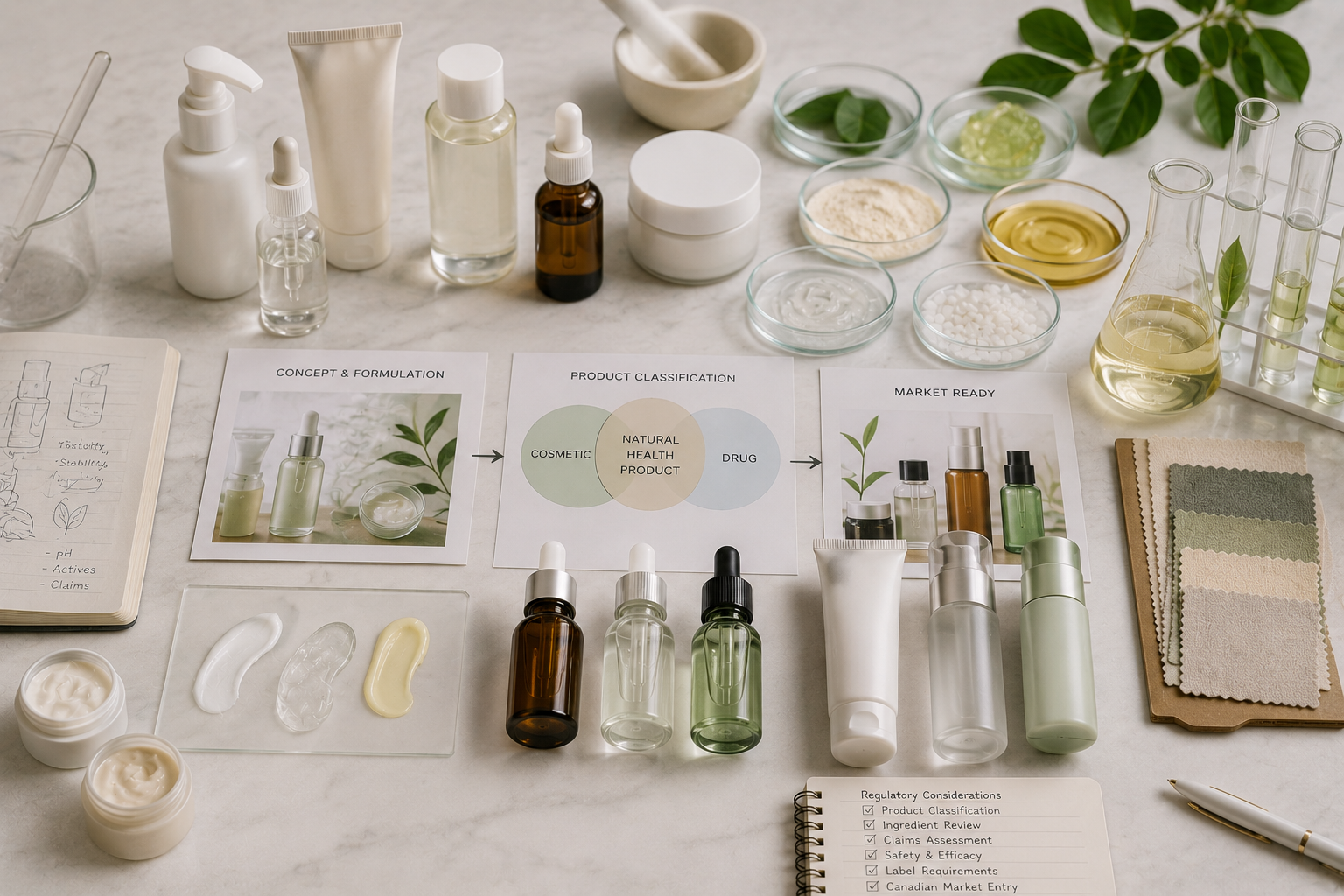
This is a different track from how most pure cosmetics are handled. In Canada, products fall into one of three regulatory buckets, and the bucket decides the paperwork:
| Product type | Governing rule | Pre-market step |
|---|---|---|
| Cosmetic | Cosmetic Regulations (Food and Drugs Act) | Cosmetic Notification Form within 10 days of first sale |
| Natural Health Product | Natural Health Products Regulations | NPN (license) required before sale |
| Drug | Food and Drug Regulations | DIN or full drug approval before sale |
The key point is that a cosmetic does not get an NPN. A cosmetic gets a Cosmetic Notification. An NPN belongs to the NHP track. So the real question behind "do I need a Health Canada NPN" is usually "which bucket does my product fall into?"
When skincare needs an NPN
Most plain skincare is a cosmetic. A moisturizer that hydrates, a cleanser that cleans, a serum that improves the look of skin: these make cosmetic claims and follow the cosmetic notification route. They do not need an NPN.
Your product moves toward the NHP track, and an NPN, when it does something the regulations treat as a health function. Common triggers include:
- Therapeutic or health claims. If you say a product treats acne, relieves eczema, heals wounds, or reduces inflammation, you have left cosmetic territory.
- Certain active ingredients used at functional levels. Ingredients with a recognized medicinal role can push a product into NHP or drug classification depending on concentration and claim.
- Antiseptic, anti-dandruff, or similar functional positioning.
- Some natural sunscreens. Sunscreens are a special case in Canada and can sit under either the NHP framework or the drug framework depending on the active.
A useful test: ask whether your claim is about appearance or about altering a body function or treating a condition. Appearance claims tend to be cosmetic. Function and treatment claims tend to require an NPN or a DIN. When in doubt, the claim, not your intent, is what a reviewer reads.
NPN vs cosmetic notification at a glance
Founders often ask whether the NPN route is "more work." It is, and that work buys you the right to make stronger claims. Here is the practical comparison:
| Factor | Cosmetic notification | NPN (NHP license) |
|---|---|---|
| Timing | File within 10 days of first sale | Approve license before any sale |
| Review | Notification, no pre-market efficacy review | Pre-market review of safety and efficacy |
| Claims allowed | Appearance and cleansing claims | Health and therapeutic claims within the license |
| Evidence needed | Ingredient safety and labeling compliance | Evidence supporting each claim |
| Label requirement | Standard cosmetic labeling | Eight-digit NPN plus NHP labeling |
Choosing the cosmetic route when you can stay in appearance claims keeps your launch faster and simpler. Choosing the NPN route is worth it when a health claim is central to how the product sells. The mistake to avoid is making an NHP-level claim on a product you only notified as a cosmetic. That mismatch is exactly what attracts enforcement.
How ingredients and concentration change the answer
Two products with the same hero ingredient can land in different buckets. A vitamin C serum sold to brighten the look of skin is typically a cosmetic. A zinc-based product sold to treat a skin condition is not. Concentration matters too: an ingredient can be a benign cosmetic component at one level and a regulated active at another.
This is where formulation and regulatory work need to talk to each other early. At Hong Shin we develop the full skincare range in-house, including cleansers, toners and essences, serums and ampoules, moisturizers and creams, eye care, masks, and SPF, and we keep K-beauty actives such as PDRN, peptides, niacinamide, bakuchiol, vitamin C, hyaluronic acid, centella, and ceramides available through our South Korea capability. Made in Taiwan and South Korea, our R&D team formulates with the target market in mind, so a Canadian launch is scoped against the right bucket before the first sample is poured. You can see the active list on our ingredients page and the full product range on our offerings page.
Getting concentration and claim aligned at the formula stage is far cheaper than discovering at notification that your bottle implies a health function you did not license for.
How Hong Shin supports the Health Canada pathway
We are a contract manufacturer, established 2012, with 13 years of work and customers in 16 countries. Canadian market access is something we handle as part of the build, not an afterthought you sort out alone.
Our regulatory support covers the routes a Canadian skincare brand actually uses:
- Health Canada cosmetic notification for appearance-claim products.
- Health Canada NPN support for products that carry health claims and belong on the NHP track.
- US FDA OTC and 25(b) pathways, EU CPNP, and UKCA when you expand beyond Canada.
That support sits on top of real certification. Our facilities hold ISO 22716 cosmetic GMP and ISO 9001, plus SEDEX and BSCI for ethical and social compliance, and we maintain a US FDA-registered facility. Note that an FDA-registered facility is not the same as FDA "approval": the FDA registers facilities and regulates OTC drugs, it does not approve cosmetics. We keep that language accurate because regulators do. You can review the full list on our certifications page, and the regulatory routes in more detail on our compliance page.
A realistic timeline and minimum order
Regulatory classification is the front of the project. Manufacturing is the rest of it. Here is how a typical first run sequences once you know your bucket:
- Brief and NDA. We capture your concept, target market, and claims.
- Quote and spec, within 5 business days. This is where we flag whether your claims point to cosmetic notification or NPN.
- Sampling. We formulate and iterate.
- Pilot run. A small production batch to confirm scale-up.
- Ship and scale.
On volume, our indicative MOQ for retail bottles, tubes, and jars starts at 1,000 units per SKU for a first run, with 500 units on reorder. Bulk semi-finished product starts at 50 kg per formula. Lead time runs about 10 to 12 weeks from formula sign-off. If you want a low-commitment way to test a concept before a full run, we offer sachet sampling and kit assembly, which is a sensible first step for a brand still finalizing its Canadian claim strategy. Terms are 50% deposit and 50% before shipment, shipped FOB Taiwan or DDP.
If a health claim is core to your product, build the NPN timeline into your plan, since that license must be in hand before you sell, unlike a cosmetic notification you can file within 10 days of first sale.
Frequently asked questions
Does every skincare product sold in Canada need an NPN?
No. Most skincare is a cosmetic and needs a Cosmetic Notification Form filed within 10 days of first sale, not an NPN. You need an NPN when your product makes a health or therapeutic claim or uses a medicinal ingredient in a way that places it under the Natural Health Products Regulations.
What is the difference between an NPN and a cosmetic notification?
A cosmetic notification is a filing you make to Health Canada about a cosmetic, with no pre-market efficacy review, and it allows appearance and cleansing claims. An NPN is a license granted after Health Canada reviews safety and efficacy, it is required before sale, and it allows health claims within the terms of that license.
Can a moisturizer or serum ever require an NPN?
Yes, if it carries a health claim such as treating a skin condition, or contains a regulated active at a functional level. The same base formula can be a cosmetic or an NHP depending on the claim and concentration, which is why classification should happen at the formula stage.
Does Hong Shin handle the Health Canada filing?
We provide regulatory support for both Health Canada cosmetic notification and NPN, and we scope which route your product needs during the quote and spec stage. We also support US FDA OTC and 25(b), EU CPNP, and UKCA for brands expanding beyond Canada.
How long does a Canadian skincare launch take with Hong Shin?
Plan for about 10 to 12 weeks from formula sign-off through manufacturing. If your product needs an NPN, factor the license review into your timeline, since the NPN must be approved before you can sell.
Work with Hong Shin
If you are weighing whether your product needs a Health Canada NPN or a cosmetic notification, the fastest way to a clear answer is to put your concept and claims in front of our team. We will scope the right regulatory route, confirm the formula and concentration support your claims, and quote within 5 business days. Start by reading our compliance overview, see how a first run comes together on our private label page, and then request a quote at hello@hongshincosmetics.com or +886 965 036 658. We handle the compliance and quality control a real launch needs before you pour the first sample.