The Clean Beauty Dirty List: Ingredients Brands Avoid (and How to Formulate Around Them)
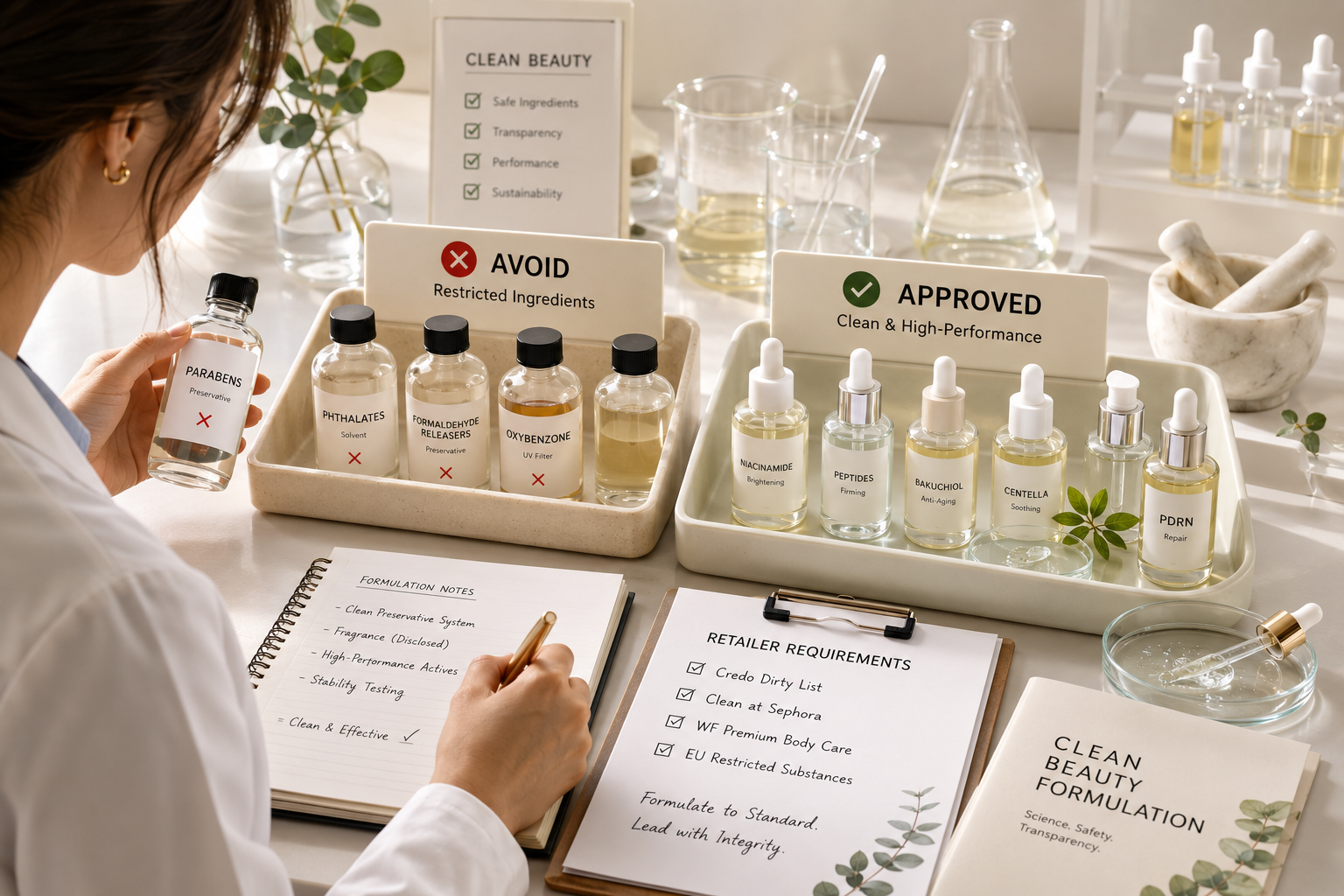
If you are building a clean beauty brand, you will run into the "dirty list" early. It is the set of ingredients that clean-focused retailers and brands choose to exclude from their products. Get it wrong and you can be turned away from a retailer like Sephora or Credo, or have to reformulate after you have already paid for a batch. This guide explains what the dirty list actually is, which ingredients commonly appear on it, and how to formulate a clean product that still performs.
What the dirty list is, and what it is not
The dirty list is a policy standard, not a single law. Clean-beauty retailers publish their own restricted-ingredient lists, and a brand that wants to be stocked has to comply. It is important to be precise here: being on a dirty list means an ingredient is restricted by that retailer's clean standard, not that it has been proven unsafe. Regulatory status varies by region, and many restricted ingredients are legal to use. Clean beauty is a positioning and eligibility choice, and the dirty list is the rulebook for it.
The lists that matter
Credo's Dirty List is one of the most cited, restricting roughly 2,700 ingredients for any brand sold through Credo.
Clean at Sephora is Sephora's standard, a shorter exclusion list a product must meet to carry the Clean seal.
Whole Foods Premium Body Care maintains its own restricted list for products on its shelves.
The EU prohibited and restricted substances list is the legal baseline in Europe, far longer than the US equivalent, and a useful floor to formulate above.
Each list is different, so the practical step is to pick the standard you are targeting (often driven by where you want to sell) and formulate to it from the start.
Ingredients commonly on the dirty list
The exact list depends on the retailer, but these categories appear again and again. Brands choose to avoid them to meet clean standards:
Parabens (certain preservatives)
Phthalates
Formaldehyde and formaldehyde-releasing preservatives
Certain sulfates such as SLS in some standards
Synthetic or undisclosed "fragrance/parfum"
Some PEGs and ethoxylated ingredients
Certain UV filters such as oxybenzone
BHA and BHT
Triclosan and triclocarban
Talc in some standards
Again, the point is eligibility and positioning, not a safety verdict. The job is to match your formula to the standard your retail and customer base expects.
How to formulate clean and still perform
The challenge is that some restricted ingredients do real work, preservation, texture, scent, so removing them means replacing them with alternatives that hold up. That is a formulation problem, not a marketing one. It usually comes down to:
Clean preservative systems that protect the product without parabens or formaldehyde releasers, validated with preservative efficacy (PET) testing.
Fragrance choices that are either fragrance-free or use disclosed, standard-compliant options.
High-performance clean actives such as PDRN, peptides, niacinamide, bakuchiol, and centella, which let a clean formula still deliver a real result.
Stability testing to confirm the reformulated product survives temperature and time before you commit to a production run.
How Hong Shin helps
Hong Shin Cosmetics specializes in clean-ingredient and botanical formulation, made in Taiwan and South Korea under ISO 22716 cosmetic GMP. We can formulate to the clean standard you are targeting, whether that is Credo, Clean at Sephora, or a market-specific baseline, handle the preservative and stability work, and keep your claims defensible. Established 2012, serving brands in 16 countries. See our ingredients and private label services.
Frequently asked questions
What is the clean beauty dirty list?
It is a retailer or brand's list of restricted ingredients that a product must avoid to qualify as clean. Credo and Sephora each publish their own version. It is a policy standard for eligibility, not a legal safety ruling.
Is the dirty list a law?
No. It is a private standard set by retailers and brands. Separately, regulators like the EU and Health Canada maintain their own legally prohibited and restricted ingredient lists, which are the legal baseline.
What ingredients are usually restricted?
Common examples include parabens, phthalates, formaldehyde-releasing preservatives, some sulfates, undisclosed synthetic fragrance, certain UV filters, BHA and BHT, and triclosan. The exact list depends on the standard.
Can a manufacturer formulate to Clean at Sephora or Credo?
Yes. A manufacturer with clean-ingredient experience can formulate to a specific retailer standard, validate the preservative system, and run stability testing so the product is both compliant and stable.
Build a clean line that qualifies
Tell Hong Shin which clean standard you are targeting and your rough volumes, and we will scope a compliant formula, MOQs, and lead times, with a quote in five business days. Email hello@hongshincosmetics.com.