How to Choose a Private Label Skincare Manufacturer: 7 Criteria
Choosing a manufacturer is the highest-stakes decision a new skincare brand makes. The wrong partner means blown timelines, products that cannot legally be sold, or minimums that bury you in unsellable inventory. This guide gives you the seven criteria that actually separate a real manufacturing partner from a relabeling operation, a comparison of the manufacturer types you will encounter, and the questions to ask before you sign anything.
The 7 criteria that actually matter
Do they own the factory, or are they a broker?
The first filter is whether you are talking to the factory or to a middleman reselling someone else's capacity. Ask directly: do you own the manufacturing site, and where is it? A real manufacturer answers without hesitation and names the location. A broker hedges.
Certifications and facility registration
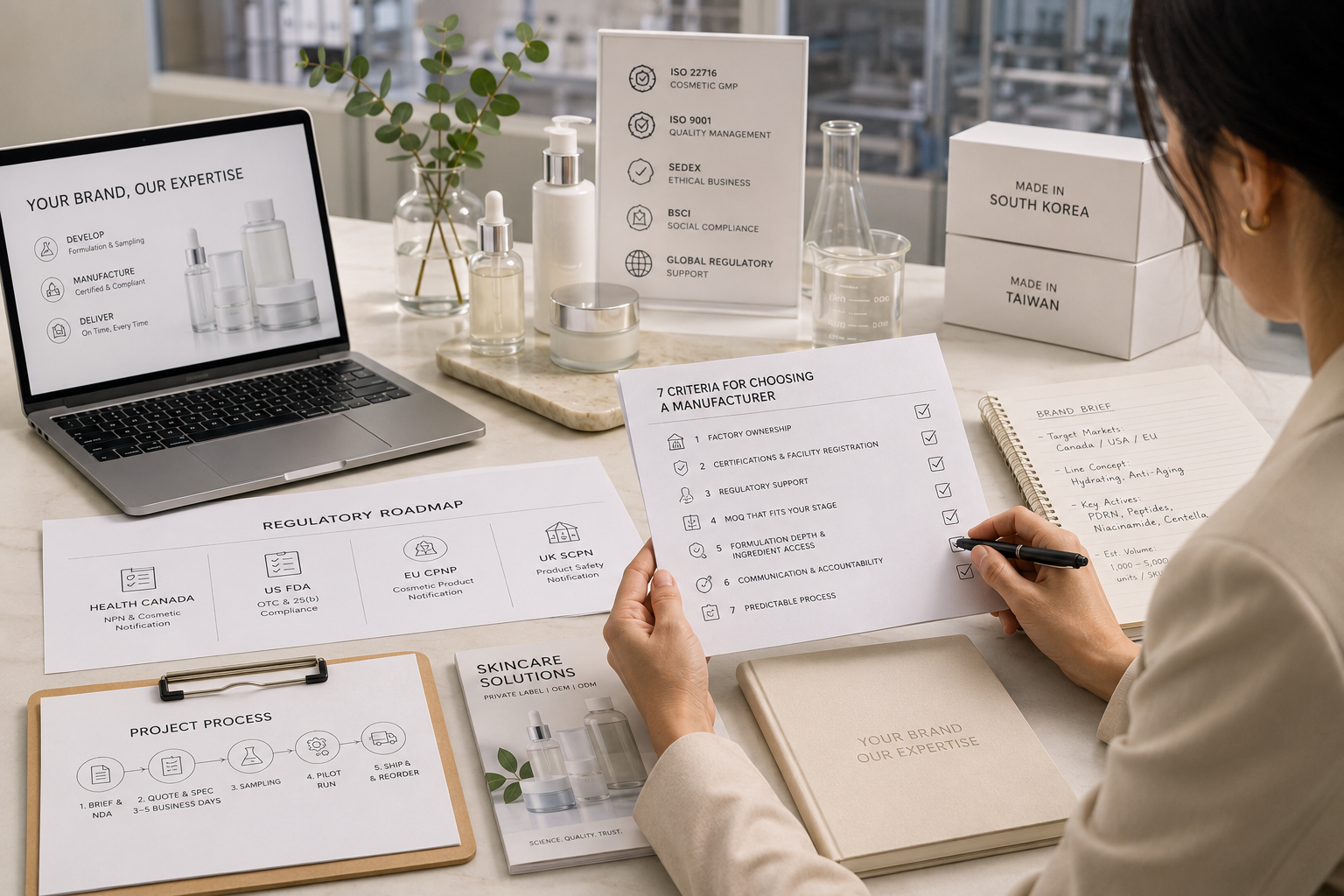
Skincare is regulated almost everywhere that matters. At minimum look for ISO 22716 (cosmetic GMP), ideally ISO 9001 (quality management), ethical audits like SEDEX and BSCI that retailers increasingly require, and facility registration in your target markets. Ask for certificate numbers and verify them. Note the wording on US claims: the FDA registers facilities and regulates OTC drugs, it does not "approve" cosmetics.
Regulatory support for your markets
This is where most first launches quietly fail. A founder approves a cheap sample, then discovers the product cannot clear customs or be listed because the paperwork never existed. Manufacturing and compliance are two different jobs. A partner that can guide Health Canada NPN and cosmetic notification, US FDA OTC and 25(b), EU CPNP, and UK SCPN removes the single biggest source of launch risk.
MOQ that fits your stage
Minimum order quantity is where excitement meets cash flow. Too low and you may be talking to a relabeler; too high and you tie up money in inventory you cannot sell fast enough. A credible custom manufacturer runs first orders from around 1,000 units per SKU with reorders lower, and a good partner offers a low-commitment on-ramp like sachet sampling so you can test demand before financing a full run.
Formulation depth and ingredient access
If your brand story leans on actives, the manufacturer's library and formulation depth become a competitive moat. Ask which actives they routinely work with. A maker with genuine K-beauty capability should be comfortable across PDRN, peptides, niacinamide, bakuchiol, vitamin C, hyaluronic acid, centella, and ceramides, and able to keep them stable in the bottle, not just on the brief.
Communication and accountability
Overseas manufacturing fails most often on the gap between a Western brand and an Asian factory across language and timezone. A partner that gives you accountable, in-language project management removes that friction. This is where a Western-owned, Asia-manufacturing model has a real advantage over a factory you manage at arm's length.
A predictable process
A serious manufacturer can describe a structured path: brief and NDA, quote and spec within a few business days, sampling, a pilot run to confirm the formula scales, then ship and reorder. If a maker cannot describe a process like this, treat it as a warning sign. Predictability is the entire point of choosing a certified partner.
The manufacturer types, compared
You will run into three broad types when sourcing. Each fits a different stage and budget.
| Criterion | Low-MOQ reseller | Large ODM | Mid-scale contract manufacturer |
|---|---|---|---|
| Typical MOQ | 10 to 100 units | 5,000+ units | ~1,000 units, reorders lower |
| Custom formulation | No, catalog only | Yes, but high minimums | Yes, private label and custom |
| Certifications | Often unverifiable | Strong | Strong (ISO 22716, ISO 9001) |
| Regulatory help (NPN/FDA/CPNP) | Rare | Sometimes | Yes, built into the project |
| Best for | A quick test, low stakes | Established brands at scale | Founders launching a real, compliant line |
Where Hong Shin fits
Hong Shin is a mid-scale contract manufacturer, established 2012, serving brands in 16 countries. We are Canadian-owned with manufacturing in Taiwan and South Korea, certified to ISO 22716 and ISO 9001, with regulatory support across Health Canada, US FDA, EU CPNP, and UK SCPN. We are not the lowest-MOQ option, and that is deliberate: the value is a real, certified, compliant product rather than the cheapest possible test batch. If you want to validate a concept first, sachet sampling is the low-commitment way in. See our private label and OEM and ODM services, or the certifications on our about page.
Frequently asked questions
What is the most important thing when choosing a skincare manufacturer?
Regulatory capability for your target markets. A beautiful sample is worthless if the product cannot legally be sold. Confirm the manufacturer handles notification and registration before you commit.
What MOQ should I expect from a private label skincare manufacturer?
For a credible custom manufacturer, expect first runs from around 1,000 units per SKU with reorders lower. Very low minimums (10 to 100 units) usually indicate a relabeler rather than a true manufacturer.
What certifications should a cosmetics manufacturer have?
ISO 22716 (cosmetic GMP) at minimum, ideally ISO 9001, ethical audits like SEDEX and BSCI, and facility registration in your target markets. Ask for certificate numbers and verify them.
Should I choose private label or custom formulation?
Private label gets you to market faster on existing formulas and suits a first launch. Custom OEM/ODM builds a proprietary formula and takes longer. Choosing a partner who offers both avoids re-tooling later.
Ready to compare?
Send Hong Shin your brief with your target markets and rough volumes, and we will return a quote and spec within five business days. Email hello@hongshincosmetics.com or request a quote on the site.