

Mineral vs Chemical Sunscreen: What's the Difference, and Which Should Your Brand Launch?
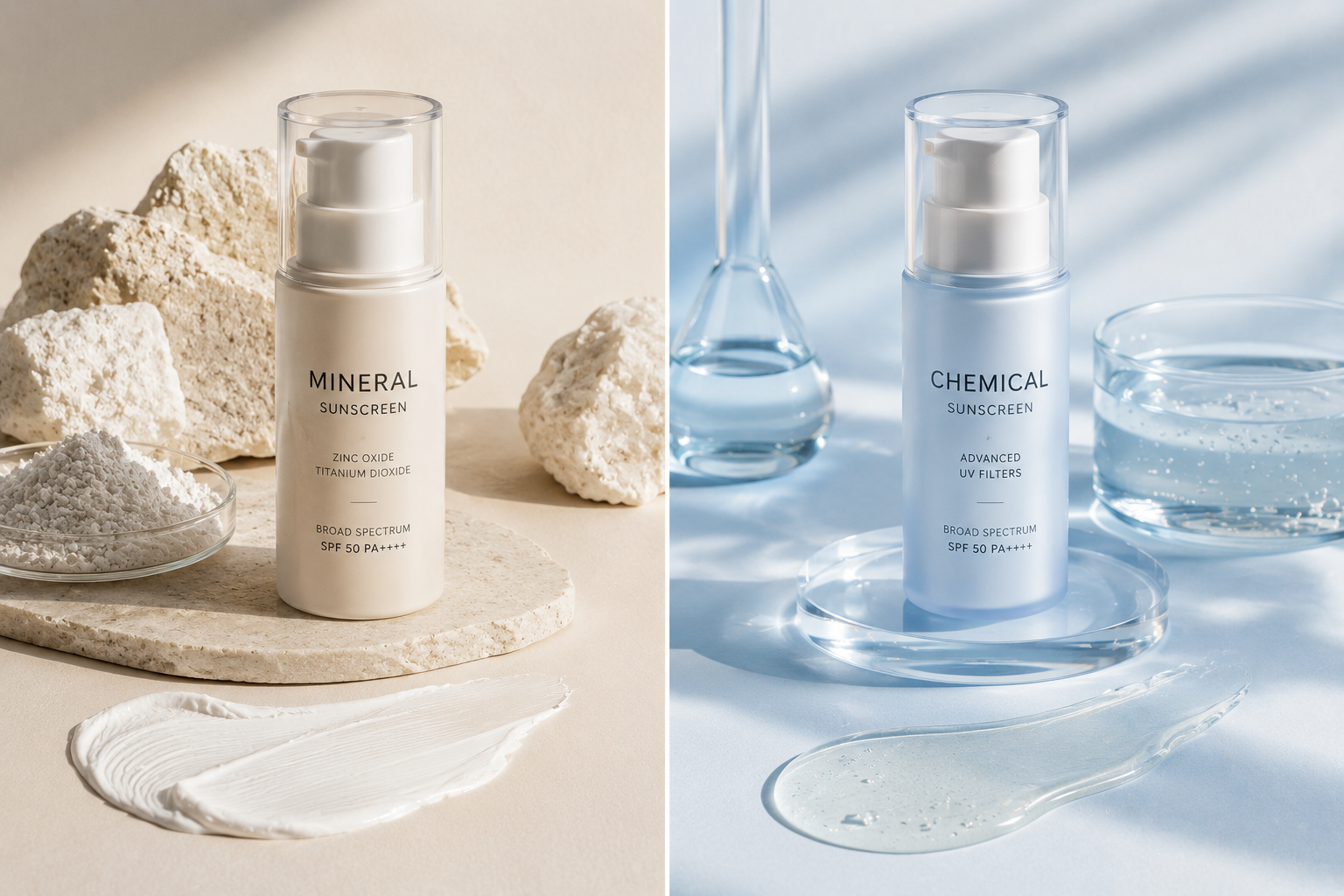
Mineral and chemical sunscreens both protect skin from UV, they just do it with different filters. Mineral sunscreens use zinc oxide or titanium dioxide. Chemical sunscreens use organic filters like avobenzone or octinoxate. Neither is universally better. The right choice for your brand depends on your customer, your positioning, and crucially, the markets you want to sell in.
What is the difference between mineral and chemical sunscreen?
The difference is the type of UV filter, and how it sits on the skin.
Mineral sunscreen (also called physical or inorganic) uses zinc oxide and titanium dioxide. These filters sit on and within the top layer of skin and block UV by both scattering and absorbing it. Zinc oxide in particular gives broad-spectrum UVA and UVB coverage. The historic downside is a white cast, especially on deeper skin tones, though modern formulation and tinting have largely solved this.
Chemical sunscreen (also called organic) uses carbon-based filters such as avobenzone, octinoxate, octisalate, homosalate, and oxybenzone. These absorb UV and convert it to a small amount of heat. They tend to feel lighter, spread more easily, and leave no white cast, which is why most cosmetically elegant, everyday sunscreens are chemical or hybrid.
| Factor | Mineral (zinc oxide, titanium dioxide) | Chemical (organic filters) |
|---|---|---|
| Feel | Heavier, can leave a white cast (reducible with tinting) | Lighter, no white cast, layers under makeup |
| Sensitive skin | Often chosen for sensitive, reactive, or rosacea-prone skin | Some filters can sting or irritate sensitive skin |
| Positioning | Favored by clean-beauty and "reef-conscious" brands | Favored for daily-wear, makeup-friendly textures |
| Filter availability | Widely permitted across markets | Varies a lot by market (see below) |
| Common use | Kids, sensitive, mineral-only positioning | Everyday face SPF, sport, broad lines |
Which is safer?
This is the question shoppers search most, and it deserves an honest answer rather than a scare. Both mineral and chemical sunscreens sold legally have been assessed by regulators. Zinc oxide and titanium dioxide are well established and are the filters most often chosen for babies, children, and sensitive or pregnant users, largely because they sit on the skin and are less likely to irritate.
Some chemical filters, oxybenzone in particular, have drawn more scrutiny over skin absorption and environmental concerns, which is why many clean-beauty brands and some regions have moved away from them. That is a brand-positioning and market-access reality, not a verdict that chemical sunscreen is unsafe. Plenty of dermatologist-recommended sunscreens are chemical. For a brand, the practical takeaway is to choose your filter system deliberately and let your claims follow the evidence, not the other way around.
The regulatory catch most founders miss
Here is the part that actually shapes a sunscreen launch. Sunscreen is not a cosmetic everywhere. In the United States it is an over-the-counter (OTC) drug, governed by a monograph with a short, dated list of approved filters and no modern UV filters added in many years. In Canada, sunscreens are regulated as drugs or natural health products and need a product licence. In the EU, Korea, and Australia, sunscreens sit under cosmetic or cosmetic-adjacent rules that allow a much wider, more modern set of filters.
What this means in practice:
A modern, elegant chemical filter system you love from a Korean sunscreen may not be legal to sell in the US.
The market you target decides the filters you can use, which decides the texture and finish you can deliver.
This has to be settled before formulation, not after, because re-filtering a sunscreen is a near-total reformulation.
Which should your brand launch?
Match the filter system to your brand and your market:
Clean, sensitive, kids, or "mineral-only" positioning: go mineral, and invest in a no-white-cast formula so the texture is not a dealbreaker.
Everyday, makeup-friendly, broad appeal: a chemical or hybrid system usually wins on feel, with filters chosen for your target markets.
Selling into the US: plan around the OTC monograph filters from the start.
Selling into Korea, the EU, or Australia first: you have access to more modern filters and lighter textures.
How Hong Shin makes sun care
Hong Shin develops, fills, and finishes sun care in-house under ISO 22716 cosmetic GMP, made in Taiwan and South Korea. We make both mineral and chemical systems across formats: serum-light fluids, sticks, mists, tinted bases, and kids and sensitive options, with a focus on lightweight, no-white-cast results. Because sunscreen rules differ by market, we scope the OTC and notification path for your target markets before sampling, so the formula you build is the formula you can actually sell. See our sun care page and private label service.
Frequently asked questions
Mineral vs chemical sunscreen, which is better?
Neither is universally better. Mineral suits sensitive, kids, and clean positioning, chemical suits lighter everyday textures. The best choice depends on your customer and the markets you sell in.
Which sunscreen is safer?
Both legally sold sunscreens are regulator-assessed. Mineral filters (zinc oxide, titanium dioxide) are most often chosen for sensitive, pregnant, and pediatric use. Some chemical filters like oxybenzone face more scrutiny, which is why many clean brands avoid them, but that is a positioning choice, not a safety verdict.
Why does mineral sunscreen leave a white cast?
Zinc oxide and titanium dioxide are white and sit on the skin. Modern formulation and tinting reduce or remove the cast, which is what a capable manufacturer should deliver.
Can I sell the same sunscreen in the US, Canada, and Korea?
Often not without changes. Sunscreen is an OTC drug in the US with a limited filter list, while Korea and the EU allow more modern filters. The target market should be decided before the formula is locked.
Build your sunscreen
Send Hong Shin your brief and target markets, and we will scope a compliant mineral or chemical sunscreen with pricing in five business days. Email hello@hongshincosmetics.com.