
Formulating with PDRN: The Problems Brands Hit, and How to Solve Them
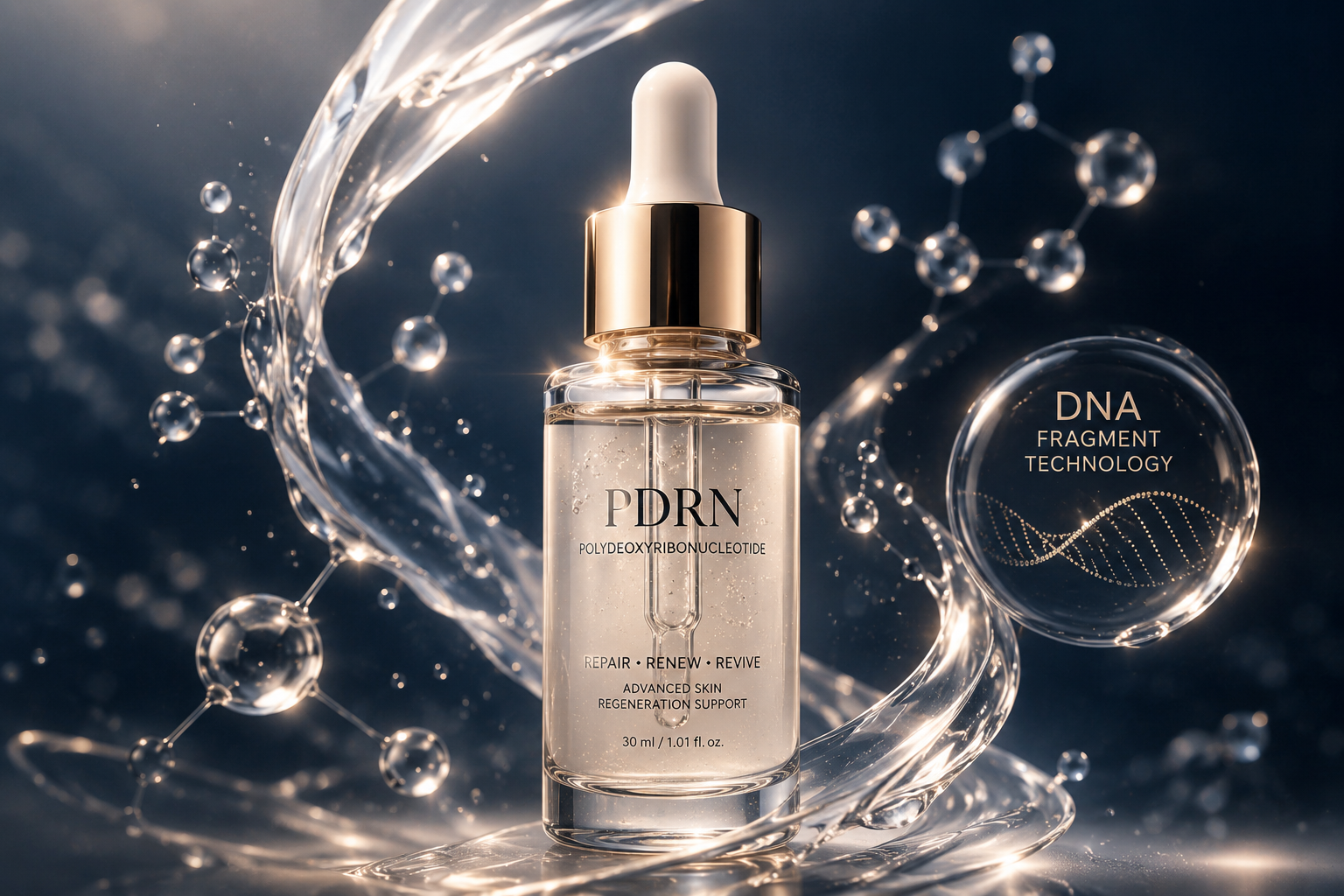
PDRN is one of the most in-demand actives in skincare right now, but it is also one of the harder ones to formulate well. It is a fragile biomolecule, it is sensitive to the rest of your formula, and its clinical heritage makes claims a minefield. Getting it wrong means a product that looks great on the brief but underdelivers on the shelf, or one that cannot legally make the claims you built your brand around. This guide walks the real problems brands hit when formulating with PDRN, the solution a capable manufacturer applies to each, and the payoff that solution delivers for your launch.
Problem 1: PDRN is fragile and degrades easily
The problem. PDRN is a chain of low molecular weight DNA fragments. Heat, the wrong pH, and time can break it down, which means the active you paid a premium for may be far weaker by the time the product reaches a customer.
The solution. Stability is engineered, not assumed. That means buffering the formula to a PDRN-friendly pH, controlling process temperature during manufacturing, choosing a delivery system that protects the molecule, and then proving it with stability testing across temperature and time before any production run.
The benefit. The product still performs at the end of its shelf life, so the story you sell is the story actually in the bottle. That protects your claims, your reviews, and your repeat-purchase rate.
Problem 2: nucleotides make preservation tricky
The problem. Nucleotides can act as a nutrient source, which raises the bar for keeping a PDRN formula safe from microbial growth, especially in clean formulations that avoid traditional preservatives.
The solution. A preservative system matched to the formula and validated with preservative efficacy (PET) testing, built to hold up without compromising the clean standard you are targeting.
The benefit. A safe, compliant, retail-ready product with the documentation buyers and regulators expect, and no risk of the contamination problems that trigger recalls.
Problem 3: PDRN clashes with low-pH actives
The problem. Founders often want a hero serum that stacks PDRN with trend actives like vitamin C or an exfoliating acid. Some of those sit at a low pH that can degrade PDRN, so a formula that looks great on paper can fall apart in the bottle.
The solution. A deliberate actives architecture. That can mean choosing compatible partners (PDRN pairs cleanly with hyaluronic acid, niacinamide, peptides, and centella), separating incompatible actives into different phases or products, or sequencing a regimen so the strong actives live in a separate SKU.
The benefit. You still get the multi-active hero label customers are looking for, without the chemistry working against itself. The result is a stable product that delivers on more than one claim.
Problem 4: claims overreach into drug territory
The problem. PDRN has a clinical and injectable heritage, so it is tempting to import words like "repairs", "regenerates", or "heals" into a topical serum. Those are drug or device claims, not cosmetic ones, and they can pull your product into a regulatory category you did not plan for, or get it rejected at customs or retail.
The solution. Scope every claim against the destination market before sampling. A topical PDRN serum is a cosmetic and should be described like one, with defensible language such as conditioning, hydration support, and helping the look of the skin barrier. Hong Shin supports Health Canada NPN and cosmetic notification, US FDA and MoCRA, and EU CPNP, so the claims are mapped to the markets you actually sell in.
The benefit. The copy your brand launches on is the copy you can keep. No reformulating after artwork, no rejected shipments, and a marketing story that holds up under scrutiny.
Problem 5: ingredient quality and sourcing vary
The problem. PDRN is most often derived from salmon or trout milt, and grade, purity, and molecular weight vary by supplier. Inconsistent raw material means inconsistent batches, and the fish origin is an allergen that has to be handled correctly on the label.
The solution. Vetted PDRN raw material with a certificate of analysis and a defined specification, batch QC with a COA on every run, and accurate allergen labeling.
The benefit. Consistent product from batch to batch and the transparency that retail buyers and customers increasingly check for before they commit.
Problem 6: a premium active is hard to fit to a price point
The problem. PDRN is not cheap, and a first-time founder can struggle to build it into a formula that still leaves a workable margin, especially at low launch volumes.
The solution. Optimize the concentration to where it is effective and defensible rather than maximal, pick the format that carries the price (serums and ampoules support a premium), and use sachet sampling as a low-commitment way to test demand before committing to a full run. Retail formats start from 1,000 units per SKU.
The benefit. A product with a margin you can defend and a launch you can de-risk, instead of an expensive batch you are not sure will sell.
How Hong Shin formulates PDRN
Hong Shin manufactures in Taiwan and South Korea, which is where the K-beauty active formulation that PDRN belongs to actually lives. We are Canadian-owned, established 2012, serving brands in 16 countries, and certified to ISO 22716 and ISO 9001. The path runs brief and NDA, quote and spec within 5 business days, sampling where the PDRN formula and the rest of the stack get dialed in, a pilot run, then ship and scale. Read the basics on the PDRN page, see how a project runs through OEM and ODM, or start with private label.
Frequently asked questions
Why is PDRN hard to formulate?
PDRN is a fragile biomolecule that is sensitive to heat, pH, and time, and it can be degraded by low-pH actives. Formulating it well requires stability work, a validated preservative system, and careful actives pairing, then stability and PET testing to prove it holds up.
Can PDRN be combined with vitamin C or retinol?
It can be challenging. Low-pH actives like vitamin C can degrade PDRN, so they are often best separated into different phases or products. PDRN pairs more cleanly with hyaluronic acid, niacinamide, peptides, and centella.
Is topical PDRN a drug or a cosmetic?
A topical PDRN serum is generally a cosmetic. The risk is in the claims. Wording like repairs or regenerates can pull a product into drug or device territory, so claims should be scoped to the destination market before launch.
What is the minimum order for a PDRN product?
Retail formats start from 1,000 units per SKU on the first run, with reorders lower. Sachet sampling is available as a lower-commitment way to test a PDRN concept first.
Build your PDRN product
Send Hong Shin your brief with your target markets and rough volumes, and we will scope a compliant, stable PDRN formula with pricing in 5 business days. Email hello@hongshincosmetics.com.