Private Label Skincare MOQ Explained (And Why Lowest Isn't Best)
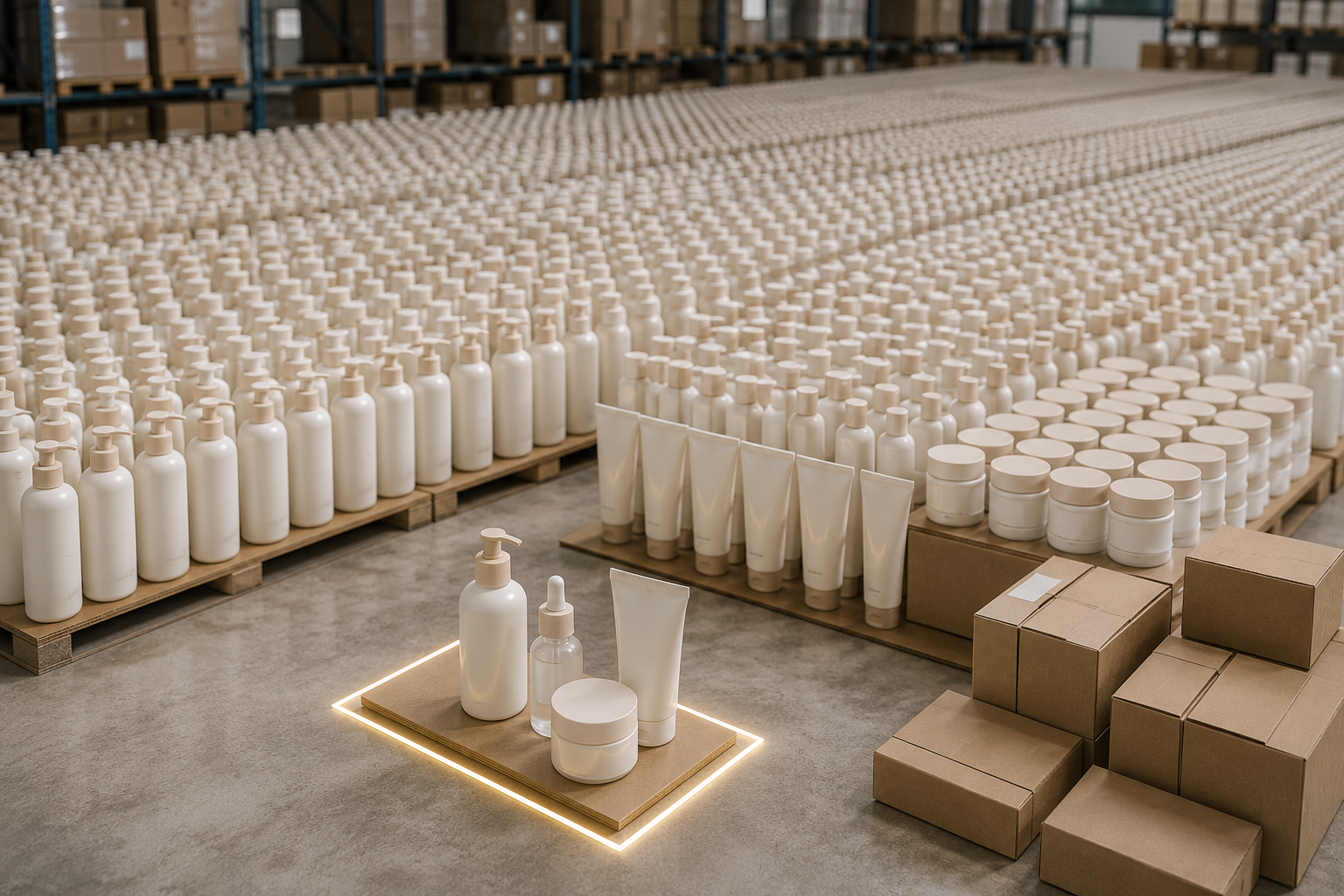
The short answer: MOQ in private label skincare is the minimum quantity a manufacturer will produce per SKU. At a certified manufacturer, expect finished units from 1,000 per SKU on a first run and 500 on reorder. The lowest MOQ is rarely the cheapest total launch cost once formulation, compliance, and testing are counted.
If you are planning a skincare brand, the first number every manufacturer quotes is the minimum order quantity. This guide gives you private label skincare MOQ explained in plain terms: what an MOQ actually covers, why minimums differ so widely between factories, and why chasing the lowest number on the table is often the most expensive mistake a founder can make. By the end you will know how to read a quote, how to plan inventory, and how to choose a partner who protects your launch rather than just your first invoice.
What MOQ Means in Private Label Skincare
MOQ is the smallest quantity a manufacturer will produce in a single run for one product. In private label skincare it is usually counted per SKU, meaning each individual finished product. A cleanser in one size is one SKU. The same cleanser in a second size is a second SKU, often with its own minimum.
Two distinct numbers sit behind the term, and confusing them leads to budget surprises:
- Bulk MOQ is the minimum amount of formula a factory will compound in one batch, usually measured in kilograms or liters. This is the chemistry.
- Finished-unit MOQ is the minimum number of filled, labeled, capped retail units. This is the packaging and assembly.
A factory can have a low bulk MOQ and still require a high finished-unit MOQ, or the reverse. When you compare quotes, confirm which number you are looking at. A headline "MOQ 500" means very little until you know whether those are units, kilos, or liters.
At Hong Shin, indicative finished-unit MOQs for retail bottles, tubes, and jars start from 1,000 units per SKU on a first run, with reorders from 500 units. Bulk semi-finished formula starts from 50 kg per formula. Those are starting points, not ceilings, and they shift with packaging type, fill volume, and formula complexity. See the full range of what we manufacture on our offerings page.
Why MOQs Vary So Much Between Manufacturers
Founders often see minimums ranging from a few hundred units to tens of thousands and assume the low number is simply a better deal. The spread usually reflects real differences in how a factory operates.
| Factor | Effect on MOQ |
|---|---|
| Filling line speed | Faster automated lines need longer runs to be efficient, which can raise minimums |
| Formula type | A simple lotion has a lower practical batch floor than a stabilized emulsion or an active serum |
| Packaging sourcing | Custom components carry their own supplier minimums that stack on top of the fill |
| Compliance depth | Factories that run full documentation and testing amortize that work over the batch |
| Reformulation vs. stock base | A stock base lowers the bar; a bespoke formula raises it |
A very low MOQ can signal a stock base relabeled for you, a shared compounding batch, or a trader passing your order to a third party. None of those are inherently wrong, but each changes what you are actually buying. A higher MOQ from a manufacturer running its own compliant batch often reflects work that protects you later.
What the MOQ Number Does Not Tell You
The MOQ is one line on a quote. The cost and risk of a launch live in everything around it. Before you compare minimums, look at what each number includes.
- Formulation ownership. Are you receiving a stock formula, a lightly tweaked base, or a custom formula developed for you? Hong Shin offers both private label using proven bases and full OEM/ODM custom formulation with in-house R&D, including IP-exclusive work where the formula stays yours. See the difference on the OEM/ODM and private label pages.
- Regulatory documentation. Selling in Canada, the US, the EU, or the UK each requires its own paperwork. A cheap unit price with no documentation can leave you unable to legally list the product.
- Testing and stability. Stability data, batch records, and safety documentation are part of a credible run.
- Certifications behind the line. Production standards determine whether a retailer or marketplace will accept your product at all.
A low MOQ that excludes these is not cheaper. It moves the cost and the risk onto you, usually after you have already paid.
The Real Cost Math: Why Lowest Isn't Best
Imagine two quotes. Quote A offers 300 units with a stock base and no regulatory support. Quote B offers 1,000 units with a custom or semi-custom formula, full documentation, and a certified production line. The per-unit price on Quote A looks better. The total launch cost often is not.
Consider what tends to happen with the rock-bottom MOQ:
- You sell out of a winner and cannot reorder cleanly. Tiny first runs leave no room to test demand. If the product moves, you scramble, and the next batch may not match.
- The cheap formula needs rework. A stock base that was not built for your claims or your market can fail stability or fall short on texture, forcing a costly redo.
- Compliance gaps surface at the border or the listing stage. Missing notifications or documentation can stall a launch after inventory is paid for.
- Cost per unit barely improves. Setup, components, labels, and testing are mostly fixed per run, so a 300-unit batch can carry a per-unit cost close to a 1,000-unit batch once everything is counted.
The lowest MOQ optimizes for the smallest possible first invoice. A launch is optimized by the lowest total cost to get sellable, compliant, repeatable inventory on a shelf. Those are rarely the same number.
How to Plan Your First Order
A first order should be large enough to prove the product and small enough to limit downside. Use a simple framework.
- Estimate honest first-90-day demand. Base it on your real audience and channels, not best-case projections.
- Match the MOQ to a sell-through you believe in. A 1,000-unit run you can move in a few months beats a 5,000-unit run that ages in a warehouse. Skincare has shelf life, and aging stock is a real loss.
- Plan the reorder before the first run ships. Knowing the reorder minimum, which at Hong Shin starts from 500 units, lets you reorder a proven product without overcommitting on day one.
- Start with sampling when the concept is unproven. Hong Shin offers sachet sampling and kit assembly as a low-commitment way to test a formula, build a sales kit, or validate a concept before you commit to a full retail run.
The goal is a first order that gives you room to learn and a clear path to scale, not the smallest number you can find.
How Hong Shin Approaches MOQ and Onboarding
Hong Shin is a contract cosmetics manufacturer established in 2012, with 13-plus years of production and customers in 16 countries. Products are genuinely made in Taiwan and South Korea, which gives access to K-beauty actives such as PDRN, peptides, niacinamide, bakuchiol, vitamin C, hyaluronic acid, centella, ceramides, and AHA/BHA. You can review the full active and ingredient range on the ingredients page.
The production floor is built to standards that retailers and marketplaces expect:
- ISO 22716 cosmetic GMP and ISO 9001
- SEDEX and BSCI for ethical and social compliance
- US FDA-registered facility
Note the wording. The FDA registers cosmetic facilities and regulates OTC drugs. It does not approve cosmetics, so anyone promising an FDA-approved cream is overstating. You can see the full list on the certifications page.
Regulatory support is part of the onboarding rather than an afterthought. Hong Shin supports Health Canada NPN and cosmetic notification, US FDA OTC and 25(b) pathways, EU CPNP, and UKCA, which matters the moment you sell across borders. The compliance page covers each pathway in more detail.
The process is staged so you are never committing blind:
- Brief and NDA
- Quote and spec, returned within five business days
- Sampling
- Pilot run
- Ship and scale
Typical lead time runs 10 to 12 weeks from formula sign-off. Terms are a 50% deposit with the balance before shipment, available FOB Taiwan or DDP.
This is the positioning in one line. Hong Shin is not the lowest-MOQ option. It is the certified, regulatory-capable custom manufacturer that handles the compliance and quality control a serious launch needs, with K-beauty formulation access built in.
Frequently Asked Questions
What is a typical MOQ for private label skincare?
Minimums vary widely by factory and product. As an indicative range, Hong Shin starts retail finished units from 1,000 per SKU on a first run, with reorders from 500 units, and bulk semi-finished formula from 50 kg per formula. Always confirm whether a quoted MOQ refers to units, kilograms, or liters, because those are very different numbers.
Why are some MOQs so much lower than others?
A very low minimum often reflects a stock base, a shared compounding batch, or an order being passed to a third party. A higher minimum from a manufacturer running its own compliant batch usually includes formulation, documentation, and testing that a bare-bones quote leaves out. Compare what is inside the number, not just the number.
Is a lower MOQ always cheaper overall?
No. Setup, packaging components, labeling, and testing are largely fixed per run, so a very small batch can carry a per-unit cost close to a larger one. When you add reformulation, reorder friction, and compliance gaps, the lowest MOQ is frequently the highest total launch cost.
Can I test a formula before committing to a full run?
Yes. Hong Shin offers sachet sampling and kit assembly as a low-commitment way to validate a formula or build a sales kit before placing a full retail order. This is a practical first step when a concept is still unproven.
How long does production take?
Typical lead time is 10 to 12 weeks from formula sign-off. The full process runs through brief and NDA, quote and spec within five business days, sampling, a pilot run, then ship and scale.
Work with Hong Shin
If you are weighing MOQs and want a quote that shows what each number actually includes, send your brief and we will return a spec and pricing within five business days. Start on the private label page, or if you need a custom formula developed and owned by your brand, see the OEM/ODM page. Reach the team at hello@hongshincosmetics.com or +886 965 036 658, Taipei, Taiwan.