How Much It Costs to Make a Skincare Line in 2026 (Real Numbers)
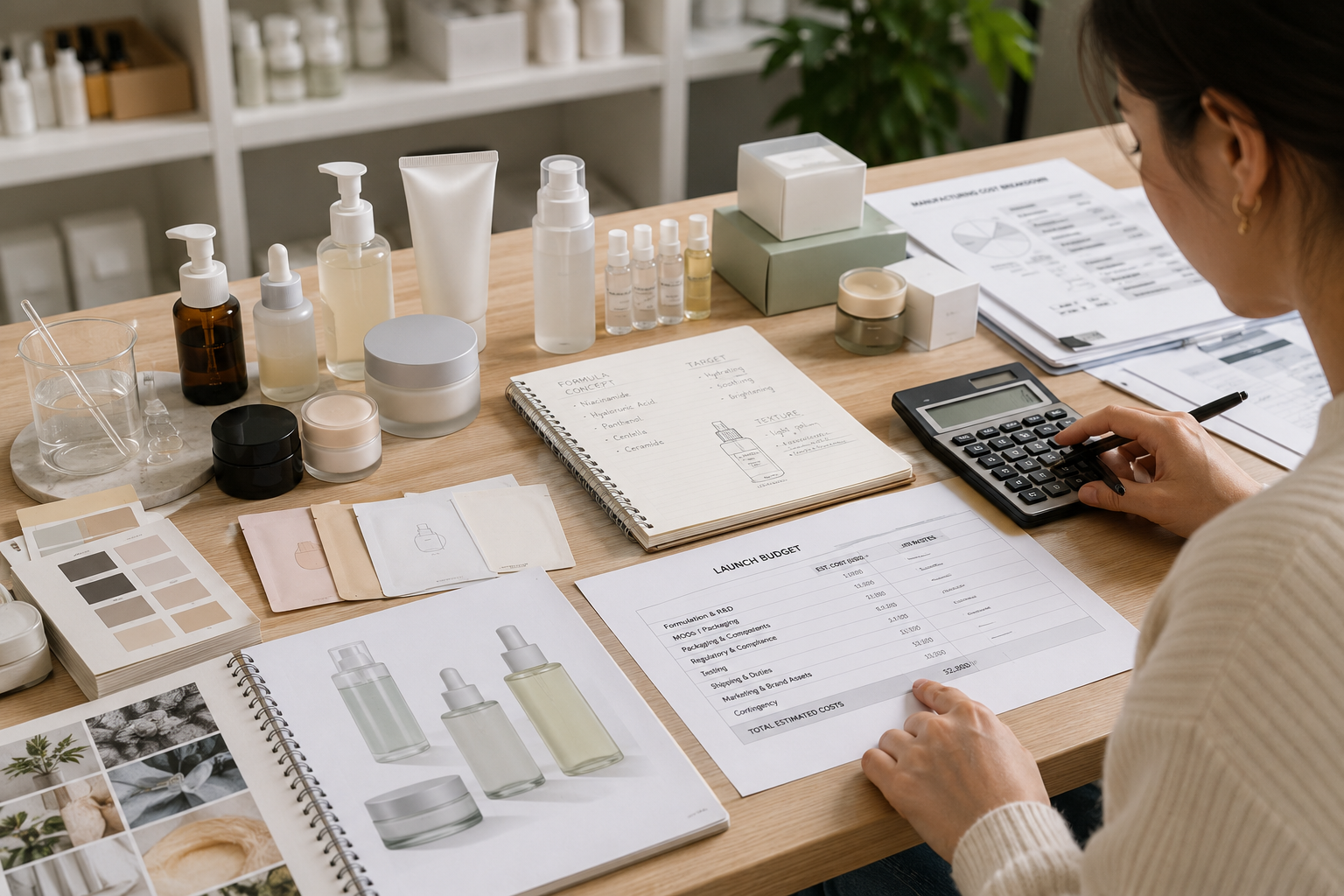
The short answer: A lean first run of one to three SKUs at modest volume typically falls between USD 8,000 and USD 40,000 all in. The range depends on whether you use private label or custom formulation, stock or custom packaging, and how many markets you file for. Narrowing to one or two hero products keeps costs at the lower end.
If you are planning a launch, the first question is almost always the same: how much does it cost to make a skincare line? This guide breaks the answer into real number ranges for formulation, minimum order quantities, packaging, compliance, and shipping, so you can build a budget that holds up. We will use concrete figures from contract manufacturing, including indicative MOQs and lead times, rather than vague estimates.
The short answer: what a first run actually costs
There is no single price tag, because a skincare line is a stack of separate costs that move independently. A realistic first run for one to three SKUs, ordered at modest volume from a certified manufacturer, typically lands somewhere between USD 8,000 and USD 40,000 all in. The spread is wide because the variables are wide. A simple wash-off product in stock packaging sits near the bottom. A custom-formulated serum with K-beauty actives, bespoke packaging, and multi-market regulatory filings sits near the top.
The honest way to answer how much it costs to make a skincare line is to price each layer on its own, then add them up. Below are the layers that matter most, with the number ranges you should plan around in 2026.
Cost layer 1: formulation and R&D
Formulation is where your product is actually decided, and it is the layer founders most often underestimate.
- Private label (use an existing tested formula): lowest cost and fastest. You are paying for the bulk and the fill, not for development. This is the cheapest route to a real product.
- OEM/ODM custom formulation: you pay for in-house R&D time, lab samples, stability testing, and revisions. Expect a development investment per formula that scales with complexity. A straightforward moisturizer costs less to develop than a multi-active ampoule.
- IP-exclusive formulas: if you want a formula that belongs to your brand and is not sold to anyone else, that exclusivity carries a premium but protects your differentiation long term.
Hong Shin offers all three routes, with custom formulation backed by in-house R&D. The South Korea capability gives access to current K-beauty actives including PDRN, peptides, niacinamide, bakuchiol, vitamin C, hyaluronic acid, centella, ceramides, and AHA/BHA. If active selection is driving your formulation budget, our ingredients page covers what is available and how it affects cost. See the full range of products we manufacture on our offerings page.
Cost layer 2: minimum order quantities
MOQs decide how much inventory cash you commit on day one, so they often matter more than unit price.
| Order type | Indicative MOQ | Notes |
|---|---|---|
| Retail bottles, tubes, jars (first run) | from 1,000 units per SKU | finished, filled, ready to sell |
| Reorder (same SKU) | from 500 units | lower commitment once proven |
| Bulk semi-finished | from 50 kg per formula | you handle fill and pack |
| Sachet sampling | low minimums | low-commitment first project |
A common mistake is ordering more SKUs than you can fund. Three SKUs at 1,000 units each is three separate MOQs, not one. If your budget is tight, narrow your first run to one or two hero products and prove demand before you broaden the range.
For founders who are not ready to commit to full retail runs, sachet sampling and kit assembly let you test a formula and a market in front of real customers first. This is one of the lowest-risk ways to start.
Cost layer 3: packaging and components
Packaging is frequently the single largest line item, and it is easy to lose control of it.
- Stock packaging: off-the-shelf bottles, jars, and tubes are the affordable choice and keep your first run lean.
- Custom packaging: custom molds, secondary cartons, unboxing experiences, and special closures add real cost and lengthen lead times, because tooling and printing run on their own clock.
- Decoration: labels, silk-screening, hot stamping, and box printing each carry setup fees that are spread across your order. Small runs feel expensive per unit because the setup is fixed.
A practical rule: keep packaging simple for run one, validate the product, then invest in custom components once you know the line sells. Premium packaging on an unproven product is the fastest way to tie up cash.
Cost layer 4: regulatory and compliance
This is the layer that gets skipped in cheap quotes and then blocks the launch. You cannot sell what you cannot legally place on the shelf, and each market has its own pathway.
- Health Canada: NPN registration where applicable, plus cosmetic notification.
- United States: FDA OTC pathways for products that make drug claims (for example SPF), plus 25(b) handling for certain natural products. Note that the FDA does not approve cosmetics. It registers facilities and regulates OTC drugs, so the right phrasing is an FDA-registered facility.
- European Union: CPNP notification.
- United Kingdom: UKCA requirements.
Each pathway has its own documentation, testing, and timeline. Budget for it from the start rather than treating it as an afterthought. Hong Shin provides regulatory support across these markets, and the compliance page explains what each pathway requires before you commit to a target geography.
The reason a certified manufacturer matters here is that the paperwork rests on the facility behind it. Hong Shin holds ISO 22716 (cosmetic GMP), ISO 9001, SEDEX, BSCI, and US FDA facility registration. Those certifications are what let your filings clear and what serious retailers ask to see before they shelve a brand.
Cost layer 5: lead times and cash flow timing
Time is a cost, because money is committed long before any product is sold. Plan your cash flow around the real calendar.
- From formula sign-off, expect roughly 10 to 12 weeks to a finished, shipped product.
- Custom packaging and regulatory filings can run alongside production, but they can also extend the timeline if they start late.
- Payment terms are commonly 50% deposit and 50% before shipment, so you are funding the bulk of the order before it reaches you.
The Hong Shin process runs in clear stages: Brief and NDA, then Quote and Spec (within 5 business days), then Sampling, then a Pilot Run, then Ship and Scale. The pilot run stage exists specifically to catch problems before you commit to full volume, which protects both your budget and your launch date.
Cost layer 6: shipping, duties, and landed cost
The price at the factory is not the price on your shelf. What you actually pay to get sellable inventory in hand is the landed cost.
- FOB Taiwan means you take ownership at the port and arrange freight, insurance, and import yourself. Lower headline price, more for you to manage.
- DDP means delivered duty paid, with freight and import handled for you. Higher headline price, far simpler.
For a first-time founder, DDP often removes enough logistics risk to be worth the premium. As volume grows and you build freight relationships, FOB can lower your landed cost per unit. Hong Shin quotes both FOB Taiwan and DDP, so you can compare the true landed numbers rather than guessing.
Putting it together: a sample first-run budget
Here is how the layers stack for a lean, realistic launch of two SKUs at MOQ, using stock packaging and one target market.
| Layer | What drives it | Where to economize |
|---|---|---|
| Formulation | private label vs custom, active selection | start with private label or simpler actives |
| MOQ inventory | units per SKU, number of SKUs | fewer SKUs at run one |
| Packaging | stock vs custom, decoration setup | stock components first |
| Compliance | number of markets, claim types | one market first, add later |
| Lead time and terms | 10 to 12 wk, 50/50 payment | plan cash flow early |
| Shipping | FOB vs DDP, duties | DDP to simplify, FOB at scale |
The takeaway: a disciplined first run keeps most of these layers at their lower bound, which is how founders launch a real, compliant product without overcommitting cash.
Frequently asked questions
How much does it cost to make a skincare line for a first-time founder?
A lean first run of one to three SKUs at modest volume typically falls between USD 8,000 and USD 40,000 all in, depending on whether you use private label or custom formulation, stock or custom packaging, and how many markets you file for. Narrowing to one or two hero products keeps the figure at the lower end.
What is the minimum order quantity for a skincare product?
At Hong Shin, retail bottles, tubes, and jars start from 1,000 units per SKU on a first run, with reorders from 500 units. Bulk semi-finished product starts from 50 kg per formula. Sachet sampling is available at low minimums for a low-commitment first project.
How long does it take to make a skincare line?
Plan for roughly 10 to 12 weeks from formula sign-off to a finished, shipped product. Custom packaging and regulatory filings can run in parallel, but starting them late can extend the timeline.
Can I sell my skincare line in Canada, the US, the EU, and the UK?
Yes, with the right filings for each market. That means Health Canada NPN and cosmetic notification, US FDA OTC and 25(b) handling where relevant, EU CPNP, and UKCA. Each pathway has its own documentation and timeline, which is why it pays to choose target markets before production begins.
Is the cheapest manufacturer the best choice?
Not usually. Cheap quotes often leave out compliance, testing, and stability work, which then blocks the launch or causes recalls. A certified, regulatory-capable manufacturer costs more on paper but handles the compliance, testing, and quality control that a serious launch needs, which protects the much larger investment you are making in your brand.
Work with Hong Shin
Hong Shin Cosmetics is a contract manufacturer, established in 2012, with 13+ years of experience and customers in 16 countries. We make in Taiwan and South Korea, with full skincare, body care, sun care, and pet wellness capability backed by ISO 22716, ISO 9001, SEDEX, BSCI, and US FDA facility registration. If you want real numbers for your specific line, request a quote and we will return a spec within 5 business days. Start with our private label route for the fastest path to market, or explore OEM/ODM custom formulation if you want a formula built around your brand. Reach us at hello@hongshincosmetics.com.