MoCRA Explained: What US Cosmetic Brands Must Do
If you are launching a cosmetic in the United States, MoCRA is the acronym that keeps coming up, and it changes the paperwork behind your product more than anything has in decades. This guide answers the question founders keep asking, what is MoCRA, and walks through the core obligations in plain language, where brands get tripped up, and how working with a certified, FDA-registered manufacturer supports your MoCRA readiness so the compliance work is done before you ship, not after.
One note up front. This is a founder-facing explainer, not legal advice. Use it to understand the landscape and to ask better questions, then confirm the specifics for your product and markets with your own regulatory advisor.
What is MoCRA, in plain terms
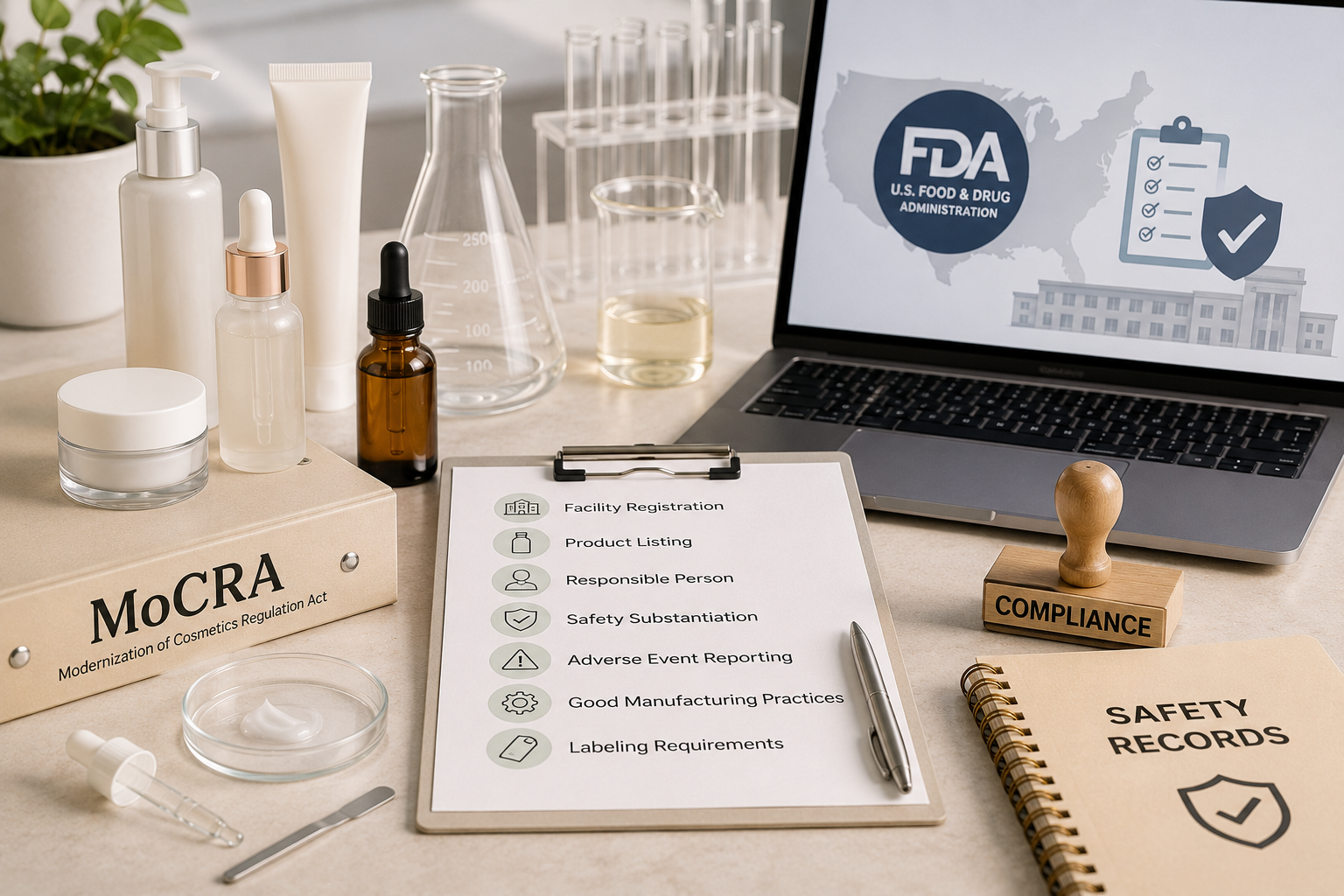
MoCRA stands for the Modernization of Cosmetics Regulation Act. It is the biggest update to US cosmetics law in generations, and it hands the FDA real oversight of cosmetics for the first time in a meaningful way. So when someone asks what is MoCRA, the short answer is this. It is the federal framework that now requires cosmetic companies to register their facilities, list their products, name a responsible party, keep safety and adverse-event records, and meet labeling rules, all under FDA enforcement.
Here is the single most important thing to understand about MoCRA cosmetics oversight, and it is the point brands most often get wrong. The FDA registers facilities and reviews records. It does not approve cosmetics. There is no such thing as an FDA-approved lotion or serum. A cosmetic goes to market on the strength of its own safety substantiation and correct labeling, not on a government sign-off. Any supplier or marketing claim that implies FDA approval of a cosmetic product is inaccurate and a compliance risk in itself.
MoCRA does not turn your cosmetic into a drug, either. A moisturizer is still a cosmetic. What MoCRA does is put structure and recordkeeping around that cosmetic, so the same honest-claims discipline that has always mattered now sits inside a formal system with names, numbers, and files attached.
Why MoCRA matters for US cosmetic brands in 2026
For a long time, launching a cosmetic in the US felt light on federal paperwork compared with Canada or the EU. MoCRA closes that gap. In 2026 the practical reality is that a US launch now carries registration and listing obligations that a brand cannot skip, and the party on the hook is often the brand owner, not just the factory.
A few reasons MoCRA compliance sits at the front of launch planning right now:
• Facility registration and product listing are ongoing obligations, not one-time forms, with renewal and update cycles to maintain.
• The Responsible Person named on the label carries real duties, including safety records and adverse-event reporting.
• Retailers and marketplaces increasingly ask for proof of MoCRA readiness before they shelve or list a product.
• Getting it wrong is a supply-chain problem, not just a legal one, because a product without correct listing and labeling can be held up on its way to shelf.
The brands that handle MoCRA well treat it as part of the manufacturing project from day one, not as a scramble after the formula is locked. That is the difference between a launch that stays on schedule and one that slips while paperwork catches up.
The core MoCRA requirements, in order
MoCRA is easier to hold in your head if you separate it into its main obligations. Here is what the law asks of a cosmetic brand and its manufacturer.
• Facility registration. Establishments that manufacture or process cosmetics for the US market register with the FDA and renew on the required cycle. This is where the FDA-registered facility status matters, and it is the manufacturer's responsibility to hold and maintain it.
• Product (cosmetic) listing. Each marketed cosmetic product is listed with the FDA, including its ingredients. Listings are kept current as formulas or products change.
• Responsible Person. Every product names a Responsible Person, the party accountable for the product's safety records, labeling, and adverse-event reporting. For many brands this is the brand owner or importer, so it is worth confirming who holds this role in your setup.
• Safety substantiation. Brands must have adequate substantiation that the product is safe under normal or expected use, and keep the supporting records. This is where formulation, testing, and documentation from the lab feed directly into your compliance file.
• Adverse event recordkeeping and reporting. The Responsible Person keeps records of health-related complaints and reports serious adverse events to the FDA within the required window.
• Labeling. Labels must carry the required information, including contact details for reporting adverse events, and must follow the honest-claims rules that separate a cosmetic from a drug.
That last point, labeling and claims, is where good products still get into trouble. MoCRA does not change the line between a cosmetic and a drug, but it does put your claims on the record. Use this framing as a starting point, then have it reviewed for your specific product:
| Claim type | Example wording | Where it usually fits |
|---|---|---|
| Cosmetic, defensible | "Hydrates and helps skin look smoother" | A cosmetic claim, with safety substantiation on file |
| Cosmetic, needs support | "Supports the look of a healthy skin barrier" | Possible, requires evidence and careful phrasing |
| Drug or device territory | "Treats eczema", "Repairs skin", "Heals" | Not a cosmetic claim. Triggers OTC drug rules and different registration. |
The moment a claim promises to treat, repair, or heal, the product is being marketed as a drug, and it moves under OTC drug rules rather than cosmetic ones. A cosmetic should be described like a cosmetic. Keeping the copy honest is what keeps the MoCRA listing you file matching the product you actually sell.
How a certified manufacturer supports your MoCRA readiness
MoCRA is a shared job between the brand and the factory, and the manufacturer carries a large part of it. This is where the certifications behind a contract manufacturer stop being a badge on a website and start doing real work.
Hong Shin Cosmetics operates an FDA-registered facility under ISO 22716 cosmetic GMP and ISO 9001. In practical MoCRA terms, that support looks like this:
• The FDA-registered facility satisfies the establishment-registration side of MoCRA on the manufacturing end, so that piece is handled where the product is actually made.
• ISO 22716 cosmetic GMP is the good manufacturing practice framework that underpins consistent, documented production, which is the foundation of safety substantiation.
• The lab work, ingredient records, and stability testing that go into a formula become part of the documentation your Responsible Person relies on.
• Correct ingredient disclosure and label content are scoped during the project, not reverse-engineered after a listing is filed.
To be precise about roles, a manufacturer holding an FDA-registered facility does not make the brand's own obligations disappear. You still name a Responsible Person, keep your safety and adverse-event records, and file your product listing. What a certified manufacturer does is make each of those steps supportable with real documentation, which is exactly what MoCRA asks you to have on file. Hong Shin is Canadian-owned, with production genuinely dual-origin, Made in Taiwan and South Korea, and 13-plus years of building products that have to clear paperwork like this across 16 countries.
How a MoCRA-ready launch works with Hong Shin
Hong Shin Cosmetics is a contract manufacturer with Taipei HQ, established in 2012, with 13-plus years of operation and customers in 16 countries. A MoCRA-conscious project runs through five clear stages, with the compliance thread built in rather than bolted on:
1 Brief and NDA. You share the concept, target markets, and rough volumes, and we flag the regulatory pathways in play, including MoCRA for the US.
2 Quote and spec, returned within 5 business days.
3 Sampling, where the formula, ingredient records, and label content get dialed in together.
4 Pilot run, a small validation batch before scale, with documentation that feeds your safety file.
5 Ship and scale, on FOB Taiwan or DDP terms.
Indicative commercial terms for a first project:
| Item | Indicative figure |
|---|---|
| First-run MOQ | From 1,000 units per SKU |
| Reorder MOQ | From 500 units per SKU |
| Bulk semi-finished | From 50 kg per formula |
| Lead time | 10 to 12 weeks from formula sign-off |
| Payment | 50% deposit, 50% before shipment |
| First-project option | Sachet sampling and kit assembly |
Hong Shin is not the lowest-MOQ option on the market, and that is deliberate. The value is in launching a real, compliant, documented product that stands up to MoCRA scrutiny, rather than the cheapest possible test batch. If you want to validate a concept before committing to bottles, sachet sampling is the low-commitment way in. You can see how a full project runs on the private label service page.
Certifications and regulatory pathways behind a North American launch
MoCRA covers the United States, but most brands do not launch into the US alone. The paperwork behind the product is what lets one manufacturing project serve several markets without redoing the formula for each one.
Hong Shin operates under ISO 22716 cosmetic GMP and ISO 9001, with SEDEX and BSCI for ethical and social compliance, and a US FDA-registered facility. Note the wording again, because it is the point buyers most often get wrong. The FDA does not approve cosmetics. It registers facilities and regulates OTC drugs, so the accurate claim is an FDA-registered facility, not an FDA-approved product.
On the regulatory side, support covers the pathways a North American and multi-market launch typically needs:
• US FDA OTC and MoCRA requirements for the US market
• Health Canada NPN and cosmetic notification (CNF) for Canada
• EU CPNP notification
• UKCA
For a North American launch, MoCRA and the Canadian side pair naturally. The US route runs through facility registration, product listing, and a Responsible Person, while Canada runs through a cosmetic notification form. If you are selling on both sides of the border, our Health Canada cosmetic notification guide covers the CNF side in detail, and matching both pathways to your markets early is what keeps a launch on schedule. You can read the full list of standards on the certifications page.
As always, treat this as scoping, not a legal opinion. Confirm the exact filings, timing, and responsibilities for your product with your regulatory advisor before you commit to a launch date.
Frequently asked questions
Does MoCRA mean the FDA approves my cosmetic?
No. This is the most common misunderstanding. The FDA registers facilities and reviews records under MoCRA, but it does not approve cosmetics. Your product goes to market on its own safety substantiation and correct labeling. Any claim of an FDA-approved cosmetic is inaccurate.
Who is the Responsible Person under MoCRA?
The Responsible Person is the party named on the label who is accountable for the product's safety records, labeling, and adverse-event reporting. For many brands this is the brand owner or the US importer, not the factory. Confirm who holds this role in your setup with your advisor.
Does working with an FDA-registered manufacturer cover all my MoCRA requirements?
It covers the facility-registration side on the manufacturing end and gives you the documentation to support safety substantiation. You still name a Responsible Person, file your product listing, and keep your own safety and adverse-event records. It is a shared job, and a certified manufacturer makes your part of it supportable.
What is the minimum order for a cosmetic product with Hong Shin?
Retail bottles, tubes, and jars start from 1,000 units per SKU on the first run, with reorders from 500 units. Bulk semi-finished formula starts from 50 kg. For a lower-commitment first step, sachet sampling is available.
How does MoCRA fit with a Canadian launch?
They run in parallel. The US uses MoCRA facility registration, product listing, and a Responsible Person, while Canada uses a cosmetic notification form (CNF) and, for some products, an NPN. One manufacturing project can serve both when the pathways are scoped early.
Work with Hong Shin
MoCRA is one of the clearest examples of a launch where the paperwork and the product have to move together. If you are scoping a US or North American launch, the next step is a brief and a quote. Send us the brief with your target markets and rough volumes, and we will spec a compliant formula and return pricing within 5 business days.
See how a full project runs through our private label service, review the standards behind it on the certifications page, and when you are ready, request a quote and we will take it from brief to pilot run.