Mandelic Acid Serum: A Private-Label Guide for Brands
Mandelic acid has quietly become the exfoliating acid that founders ask us to build first. It is gentle enough for sensitive and deeper skin tones, familiar enough that buyers already understand it, and premium enough to carry a real price point. This guide is not the broad ingredient explainer. It is the practical build sheet for a single SKU, how to approach a mandelic acid serum formulation, what percentages and pairings actually work, how to package it so the acid stays stable, and how a private label mandelic acid serum runs through a certified manufacturer from brief to pilot run.
What a mandelic acid serum is, in plain terms
Mandelic acid is an alpha hydroxy acid (AHA) derived from bitter almonds. What sets it apart from the other AHAs is molecule size. It is a larger molecule than glycolic or lactic acid, so it penetrates more slowly and more evenly. That slower penetration is the whole selling point. It tends to be better tolerated on sensitive skin and is often the acid of choice for deeper skin tones, where faster acids carry a higher risk of irritation and post-inflammatory marks.
As a leave-on serum, mandelic acid is a cosmetic exfoliant. It is positioned around smoother-looking texture, a more even-looking tone, and a fresher surface finish. Those are reasonable cosmetic angles. The moment the copy drifts into treating acne, fading scars, or reversing damage, the product stops being a straightforward cosmetic and starts pulling toward drug territory. More on that below, because it is where most first-time brands trip.
Why brands are launching a mandelic acid serum right now
Mandelic acid is the money spoke of the wider acid category. Interest has climbed as shoppers who found glycolic too harsh went looking for a gentler exfoliant, and social conversation has pushed it hard as the "sensitive skin" and "beginner acid" pick. That pull is what puts a mandelic acid serum near the front of launch calendars.
A few practical reasons it earns the slot:
• It reads as gentle and inclusive, which widens the addressable customer beyond acid veterans.
• It pairs cleanly in copy with niacinamide, hyaluronic acid, and other calming, hydrating stories.
• It suits deeper skin tones, an audience many exfoliant lines underserve.
• The single-serum format is simple to launch, easy to explain, and easy to price.
For most brands a mandelic acid serum works best as a hero or co-hero SKU rather than a whole line. Launch one well-formulated serum first, prove it at retail, then extend into a cleanser, a pad, or a higher-strength night version once demand is confirmed. That keeps the first project focused and the price point easy to defend.
What a mandelic acid serum does, and how to talk about it honestly
A leave-on mandelic acid serum is positioned around gentle surface exfoliation, smoother-looking texture, and a more even-looking tone. Those are cosmetic claims a brand can stand behind with substantiation. The line to watch is the gap between cosmetic language and drug language.
Use this framing as a starting point, then have it reviewed for your specific market:
| Claim type | Example wording | Where it usually fits |
|---|---|---|
| Cosmetic, defensible | "Gently exfoliates to reveal smoother, brighter-looking skin" | Most markets, with substantiation |
| Cosmetic, needs support | "Helps improve the look of uneven tone over time" | Possible, requires evidence and careful phrasing |
| Drug territory | "Treats acne", "Fades scars", "Repairs sun damage" | Not a cosmetic claim. Triggers OTC or drug rules. |
The most common mistake we see is a brand describing a cosmetic exfoliant with acne-drug language because the founder personally uses it that way. A topical mandelic acid serum is a cosmetic. It should be described like one. Our regulatory team scopes claims against the destination market before sampling, so the copy your brand builds its launch on is copy you can actually keep.
Formulating a mandelic acid serum: percentages, pairings, and pH
This is the section founders came for. A mandelic acid serum formulation lives or dies on a few decisions, and none of them are made by marketing alone.
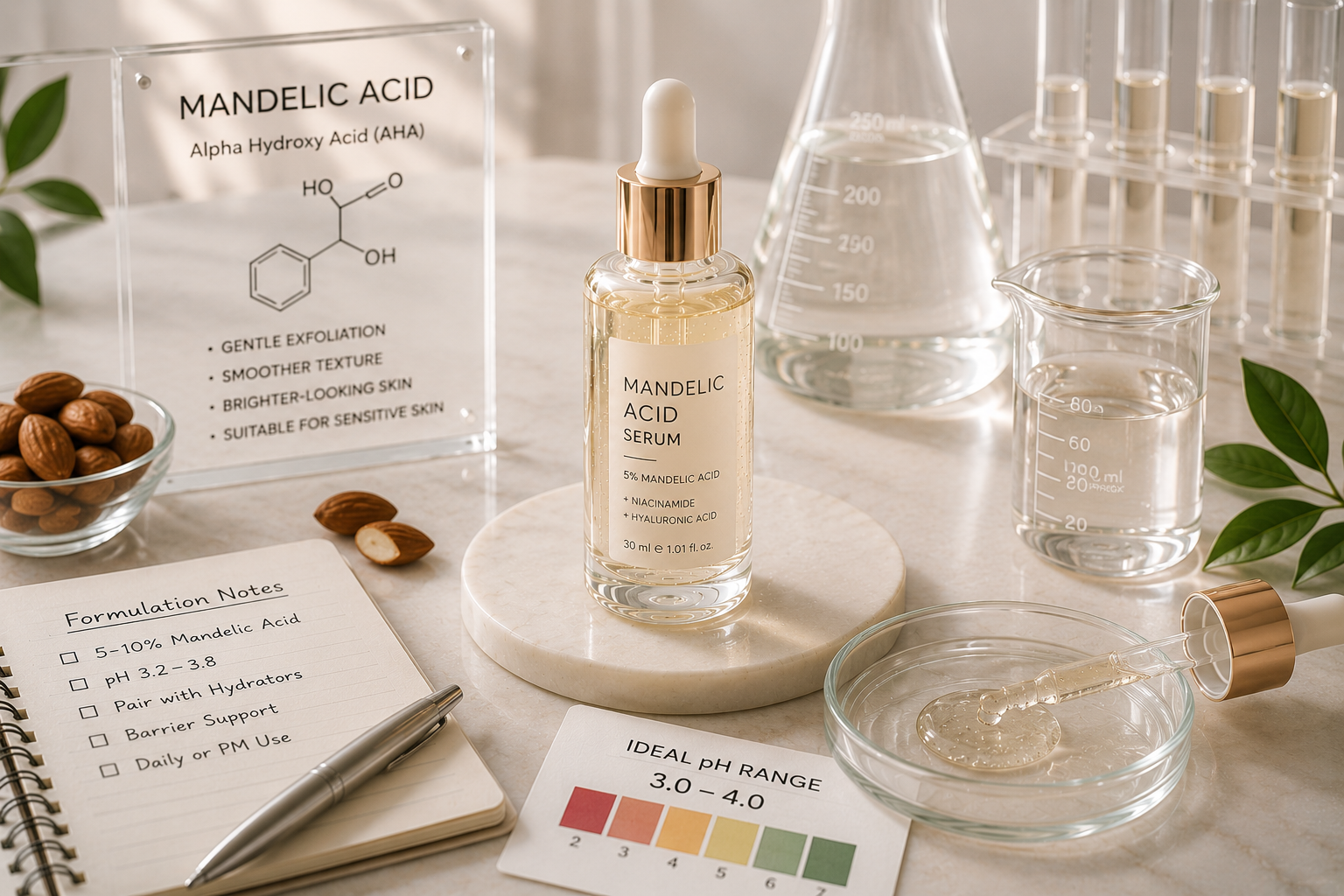
Percentage. Most leave-on mandelic serums sit in the 5 to 10 percent range. Around 5 percent is a comfortable everyday, sensitive-skin entry strength. Closer to 10 percent is a stronger, less-frequent-use position for a more experienced customer. Higher than that moves into professional and near-peel territory that carries more tolerance and labeling questions, so it is a deliberate choice, not a default. Where you land depends on the audience, the use frequency you want to recommend, and the rest of the stack.
pH. AHAs need an acidic environment to exfoliate, and mandelic acid is typically formulated in a low-pH window in the region of 3.5 to 4. Too high and the acid does little. Too low and tolerance suffers. The exact target is set in the lab against the percentage and the market, then confirmed in testing rather than assumed from a spec sheet.
Pairings. Some combinations are clean, others need care:
• With hyaluronic acid, a natural pairing. HA adds a hydration and cushioning story that offsets the drying reputation of acids.
• With niacinamide, a popular tone-and-barrier pairing. It formulates well when the pH and order are handled correctly, which is a lab decision, not a marketing one.
• With other exfoliating acids (glycolic, lactic, salicylic) or with retinol, use caution. Stacking multiple actives raises the irritation and stability burden and needs to be tested rather than assumed. Many strong launches keep the serum as a focused single-acid product and let the customer layer.
Stability. A low-pH acid formula has to survive stability testing across temperature and time before it earns a pilot run. A formula that looks good on a brief still has to hold its pH, its color, and its sensory feel over shelf life. This is why the in-house R&D and testing step is not optional.
Packaging a mandelic acid serum for stability
Packaging is part of the formulation on an acid product, not an afterthought chosen at the end. Two priorities drive the pack:
• Opaque, not clear. Light exposure can degrade a leave-on acid over time, so opaque or tinted glass and coated components protect the formula better than a clear bottle that looks nice on a shelf render.
• Airless or well-sealed dosing. Airless pump bottles and droppers with good closures limit air and contamination exposure across the life of the bottle, which helps hold pH and sensory quality. For a low-pH serum this matters more than for a basic hydrator.
The pack decision interacts with cost, fill volume, and the price point you want to hit, so it is scoped alongside the formula during quoting rather than bolted on afterward.
How a mandelic acid serum launch works with Hong Shin
Hong Shin Cosmetics is a Canadian-owned contract manufacturer with Taipei HQ, established in 2012, with 13-plus years of operation and customers in 16 countries. Manufacturing is genuinely dual-origin, Made in Taiwan and South Korea, which gives access to both broad skincare production and K-beauty active formulation. You can see the range of formats we build on our serums and ampoules page.
The path from idea to shelf follows five clear stages:
1 Brief and NDA. You share the concept, target market, and rough volumes.
2 Quote and spec, returned within 5 business days.
3 Sampling, where the percentage, pH, pairings, and pack get dialed in.
4 Pilot run, a small validation batch before scale.
5 Ship and scale, on FOB Taiwan or DDP terms.
Indicative commercial terms for a first project:
| Item | Indicative figure |
|---|---|
| First-run MOQ | From 1,000 units per SKU |
| Reorder MOQ | From 500 units per SKU |
| Bulk semi-finished | From 50 kg per formula |
| Lead time | 10 to 12 weeks from formula sign-off |
| Payment | 50% deposit, 50% before shipment |
| First-project option | Sachet sampling and kit assembly |
Hong Shin is not the lowest-MOQ option on the market, and that is deliberate. The value is in launching a real, compliant, certified product rather than the cheapest possible test batch. If you want to validate a mandelic acid serum concept before committing to bottles, sachet sampling is the low-commitment way in. See how a full project runs on our private label program page.
Certifications and regulatory pathways behind a mandelic acid serum
A low-pH leave-on exfoliant is exactly the kind of product where buyers and regulators look closely, so the manufacturing and paperwork behind it matter as much as the formula.
Hong Shin operates under ISO 22716 cosmetic GMP and ISO 9001, with SEDEX and BSCI for ethical and social compliance, and a US FDA-registered facility. Note the wording. The FDA does not approve cosmetics. It registers facilities and regulates OTC drugs, so the accurate claim is an FDA-registered facility, not an FDA-approved product.
On the regulatory side, support covers the pathways a multi-market serum launch typically needs:
• Health Canada cosmetic notification (CNF), and NPN where a natural health product route applies
• US FDA cosmetic registration under MoCRA, and OTC pathways where relevant
• EU CPNP notification
• UKCA
Matching the right pathway to your target markets early is what keeps a launch on schedule, because retiming a notification after sampling is where most calendars slip. You can read more about the full manufacturing service on our OEM skincare and cosmetics page.
Frequently asked questions
What percentage should a mandelic acid serum be?
Most leave-on mandelic serums sit between 5 and 10 percent. Around 5 percent suits a gentle, everyday, sensitive-skin position, while closer to 10 percent is a stronger, less-frequent-use serum for a more experienced customer. The final number is set in the lab against your audience and the rest of the formula.
Can a mandelic acid serum be combined with niacinamide or hyaluronic acid?
Yes. Hyaluronic acid pairs cleanly and adds a hydration story. Niacinamide also formulates well when the pH and order of the actives are handled correctly, which is a lab decision. Stacking mandelic acid with other exfoliating acids or retinol needs more caution and testing.
Why does a mandelic acid serum need opaque or airless packaging?
A low-pH leave-on acid can degrade with light and air exposure over shelf life. Opaque or tinted components and airless or well-sealed dosing help hold the pH and sensory quality of the formula, which is why the pack is scoped alongside the formula, not chosen last.
What is the minimum order for a private label mandelic acid serum with Hong Shin?
Retail bottles start from 1,000 units per SKU on the first run, with reorders from 500 units. Bulk semi-finished formula starts from 50 kg. For a lower-commitment first step, sachet sampling is available.
How long does a mandelic acid serum launch take?
Plan for 10 to 12 weeks from formula sign-off to shipment, plus the sampling and pilot stages before that. A quote and spec come back within 5 business days of the brief.
Work with Hong Shin
A mandelic acid serum is one of the most approachable ways into the exfoliating-acid category, but the gentle positioning only holds if the percentage, pH, pairings, and packaging are built correctly and the claims stay cosmetic. As a Canadian-owned, certified manufacturer, Hong Shin handles that build so your brand can focus on the launch.
If you are scoping a mandelic acid serum manufacturer, the next step is a brief and a quote. Send us the concept with your target markets and rough volumes, and we will spec a compliant formula and return pricing within 5 business days.