Mandelic Acid in Skincare: Benefits, Uses & Formulation
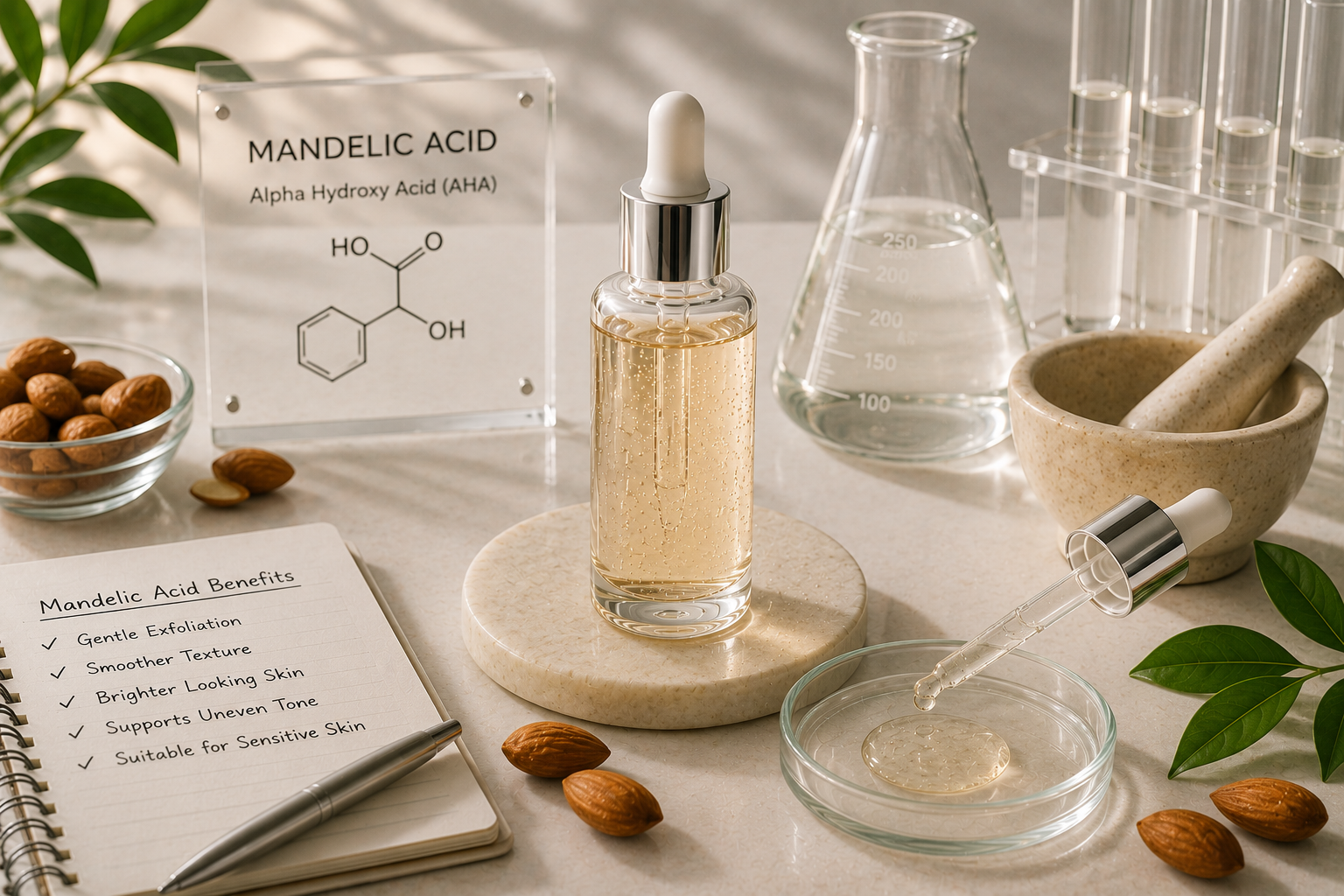
If you have looked at the exfoliant category lately, you have seen mandelic acid move from a niche derm favorite to the acid brands actually want on a launch calendar. This guide answers what buyers keep asking, what is mandelic acid and what does mandelic acid do, and walks through the benefits, the use concentrations that make sense, the pH details that matter, who it suits, and how to bring a mandelic acid line to market through a certified manufacturer that handles the formulation and compliance a real launch needs.
What is mandelic acid, in plain terms
Mandelic acid is an alpha hydroxy acid, or AHA, derived from bitter almonds. What sets it apart from the rest of the AHA family is molecular size. Its molecule is larger and heavier than glycolic acid, the AHA most people know. That larger size means it penetrates the skin more slowly and more evenly.
So when someone asks what is mandelic acid at the formulation level, the short answer is this. It is a large-molecule AHA used in topical skincare as a chemical exfoliant, valued because its slower, gentler penetration tends to be better tolerated than the smaller, faster acids. It works on the skin surface, loosening the bonds between dead surface cells so they shed more readily.
You will see it grouped with glycolic and lactic acid on ingredient lists and in category pages. All three exfoliate. The practical difference is speed and comfort, and that difference is exactly why mandelic acid has found its audience.
Why brands are launching mandelic acid lines
Consumer interest in mandelic acid has climbed alongside the wider "gentle exfoliation" and "barrier-friendly actives" conversation. Shoppers who found glycolic acid too stinging, and shoppers with sensitive, acne-prone, or hyperpigmentation-prone skin, have pushed demand toward an acid that delivers results without the sting. That pull is what has brands asking what mandelic acid does and how fast they can ship one.
A few practical reasons it sits near the front of launch calendars right now:
• It reads as the gentle, grown-up exfoliant, which supports a considered price point above a basic scrub.
• It has a strong following among people with deeper skin tones, who are often more cautious with aggressive acids because of the risk of post-inflammatory marks.
• It pairs cleanly in copy with familiar actives like niacinamide, azelaic acid, and salicylic acid for a blemish-and-tone story.
• The format is flexible. It works in serums, ampoules, toners, cleansers, and leave-on treatments.
The catch is that "gentle to talk about" and "compliant to sell" are not the same project. The brands that win with mandelic acid are the ones that lock concentration, pH, and claims before they lock launch dates.
It also helps to be honest about where mandelic acid sits in a range. For most brands it works best as a hero or co-hero SKU with a tone-and-texture story around it, rather than the whole line. A common rollout is one leave-on mandelic serum or toner first, followed by a cleanser and a targeted treatment once demand is confirmed. That keeps the launch focused and the price point easier to defend, and it leaves room for line extensions later.
What mandelic acid actually does, and how to talk about it honestly
Mandelic acid is positioned around gentle exfoliation, a smoother and more even-looking surface, brighter-looking tone, and the appearance of clearer, less congested skin. Those are reasonable cosmetic angles. The benefits people notice most are the look of refined texture, a more even-looking tone, and a fresher surface, all from surface exfoliation rather than anything happening deeper.
The line to watch is the gap between cosmetic language and drug language. Exfoliation is cosmetic. Treating a medical condition is not.
Use this framing as a starting point, then have it reviewed for your specific market:
| Claim type | Example wording | Where it usually fits |
|---|---|---|
| Cosmetic, defensible | "Gently exfoliates for smoother, brighter-looking skin" | Most markets, with substantiation |
| Cosmetic, needs support | "Helps improve the look of uneven tone and dark spots" | Possible, requires evidence and careful phrasing |
| Drug territory | "Treats acne", "Fades hyperpigmentation", "Cures breakouts" | Not a cosmetic claim. Triggers OTC or drug rules. |
The single most common mistake we see is importing treatment language into a topical exfoliant. A mandelic acid serum is a cosmetic. "Treats acne" is a drug claim, and so is language that promises to fade or cure. Describe the look and feel of the skin, not a medical outcome. Our compliance and regulatory teams scope claims against the destination market before sampling, so the copy your brand builds its launch on is the copy you can actually keep.
Formulating mandelic acid: concentrations, pH, formats, and pairings
Mandelic acid slots into most of the formats a modern skincare line needs. The two numbers that decide how a mandelic product behaves are concentration and pH, and both have to be set in the lab rather than on a marketing brief.
For leave-on products, mandelic acid is typically formulated in the range of roughly 5 to 10 percent. Lower concentrations suit an everyday, sensitive-skin-friendly product. Higher concentrations sit at the more active end and need more careful tolerability testing. Rinse-off formats such as cleansers use it differently, since contact time is short.
pH is the other lever. AHAs need a mildly acidic environment to exfoliate, but a pH that is too low trades gentleness for sting and irritation, which defeats the whole reason a brand chose mandelic acid in the first place. The formulation goal is a pH low enough to be effective and high enough to stay comfortable. That balance is set and confirmed in the lab, then proven in sampling.
Common formats for a mandelic acid launch:
• Serums and ampoules, the most popular leave-on hero format. See our serums and ampoules capability for format detail.
• Toners and essences for a daily-use, lighter-touch entry SKU
• Cleansers, where mandelic acid supports a gentle daily-cleanse story
• Leave-on treatments and pads for a more targeted texture-and-tone SKU
• Masks for sampling and gifting
A realistic formulation conversation also covers the rest of the actives stack, buffering, preservative choices, fragrance, sensory feel, and stability. Some pairings are clean, such as mandelic acid with niacinamide for a tone-and-texture serum. Others need more attention, for example stacking mandelic acid with another acid or with a retinoid, where the combined strength and the sensory result both have to be tested rather than assumed. A formula that looks good on a brief still has to survive stability testing across temperature and time before it earns a pilot run.
Who mandelic acid suits
Part of why the ingredient has grown is that it reads as the acid for people who could not comfortably use the others. Its slower penetration makes it a sensible starting exfoliant for sensitive skin, for acne-prone and congestion-prone skin, and for skin that marks easily. It has a particular following among people with deeper skin tones, who often approach aggressive acids cautiously because of the risk of leaving dark marks behind. None of that is a medical promise, and copy should not turn it into one. It is a positioning and suitability story, and it is a strong one when it stays honest.
How a mandelic acid launch works with Hong Shin
Hong Shin Cosmetics is a Canadian-owned contract manufacturer with Taipei HQ, established in 2012, with 13-plus years of operation and customers in 16 countries. Manufacturing is genuinely dual-origin, Made in Taiwan and South Korea, which is what gives access to both broad skincare production and the K-beauty active formulation that a modern acid line sits alongside.
The path from idea to shelf follows five clear stages:
1 Brief and NDA. You share the concept, target market, and rough volumes.
2 Quote and spec, returned within 5 business days.
3 Sampling, where the mandelic concentration, pH, and the rest of the stack get dialed in.
4 Pilot run, a small validation batch before scale.
5 Ship and scale, on FOB Taiwan or DDP terms.
Indicative commercial terms for a first project:
| Item | Indicative figure |
|---|---|
| First-run MOQ | From 1,000 units per SKU |
| Reorder MOQ | From 500 units per SKU |
| Bulk semi-finished | From 50 kg per formula |
| Lead time | 10 to 12 weeks from formula sign-off |
| Payment | 50% deposit, 50% before shipment |
| First-project option | Sachet sampling and kit assembly |
Hong Shin is not the lowest-MOQ option on the market, and that is deliberate. The value is in launching a real, compliant, certified product rather than the cheapest possible test batch. If you want to build a mandelic acid line under your own brand, our private-label program is the direct route, and sachet sampling is the low-commitment way to validate a concept before committing to bottles.
Certifications and regulatory pathways behind a mandelic acid product
An exfoliating acid is exactly the kind of product where buyers and regulators look at concentration, pH, and claims closely, so the manufacturing and paperwork behind it matter as much as the formula.
Hong Shin operates under ISO 22716 cosmetic GMP and ISO 9001, with SEDEX and BSCI for ethical and social compliance, and a US FDA-registered facility. Note the wording. The FDA does not approve cosmetics. It registers facilities and regulates OTC drugs, so the accurate claim is an FDA-registered facility, not an FDA-approved product.
On the regulatory side, support covers the pathways a multi-market mandelic acid launch typically needs:
• Health Canada NPN and cosmetic notification (CNF)
• US FDA OTC and MoCRA requirements where relevant
• EU CPNP notification
• UKCA
Matching the right pathway to your target markets early is what keeps a launch on schedule, because retiming a notification after sampling is where most calendars slip.
Frequently asked questions
What does mandelic acid do?
Mandelic acid is a large-molecule AHA that gently exfoliates the skin surface, loosening dead surface cells so they shed more readily. Cosmetically, that supports smoother-looking texture, a more even-looking tone, and a fresher, brighter surface. It works at the surface rather than deeper in the skin.
Is mandelic acid gentler than glycolic acid?
Its molecule is larger and heavier than glycolic acid, so it penetrates more slowly and more evenly, which tends to be better tolerated. That is why it is often chosen for sensitive, acne-prone, or mark-prone skin. Tolerance still depends on concentration and pH, which is why formulation matters.
What concentration of mandelic acid should a leave-on product use?
Leave-on mandelic products are typically formulated in the range of roughly 5 to 10 percent, with lower levels for an everyday sensitive-skin product and higher levels at the more active end. The right number depends on the format and the rest of the stack, and it is confirmed in sampling.
What is the minimum order for a mandelic acid product with Hong Shin?
Retail bottles, tubes, and jars start from 1,000 units per SKU on the first run, with reorders from 500 units. Bulk semi-finished formula starts from 50 kg. For a lower-commitment first step, sachet sampling is available.
How long does a mandelic acid launch take?
Plan for 10 to 12 weeks from formula sign-off to shipment, plus the sampling and pilot stages before that. A quote and spec come back within 5 business days of the brief.
Work with Hong Shin
Mandelic acid is one of the clearest examples of an active where the formulation details, concentration, pH, and honest claims, decide whether a launch holds up at retail. If you are scoping a launch, the next step is a brief and a quote. Send us the brief with your target markets and rough volumes, and we will spec a compliant formula and return pricing within 5 business days.
See how a full project runs through our OEM and ODM skincare service, then request a quote and we will take it from brief to pilot run.