How Snail Mucin Is Made: Sourcing & Collection
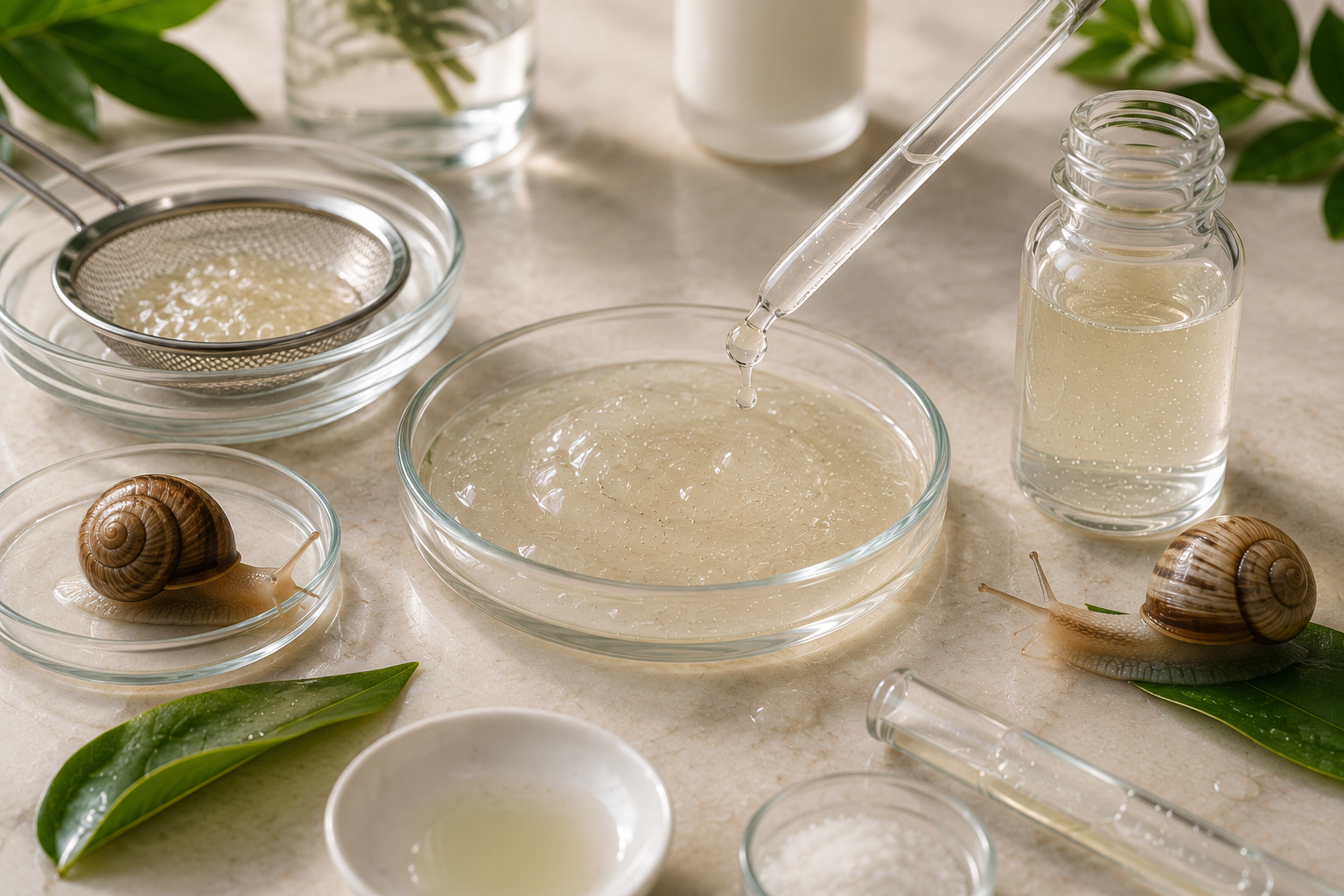
Snail mucin has become one of the most requested K-beauty actives on brand briefs, and the first question a serious buyer asks is not what it does but where it comes from. How is snail mucin collected, how is snail mucin made at ingredient grade, and how do you know the collection method was humane? This guide answers those questions from the manufacturer side, because how snail mucin is sourced and filtered decides both the quality of your product and the ethics story you can honestly tell on the label. It also walks through the private-label path for bringing a snail mucin product to market through a certified maker that handles the compliance and quality control a real launch need.
What snail mucin is, in plain terms
Snail mucin is the secretion a snail produces to move, protect itself, and repair its own shell and skin. On an ingredient list you will most often see it as snail secretion filtrate, sometimes abbreviated SSF. The species used in cosmetics is usually the common garden snail, Cornu aspersum (also written Helix aspersa).
The raw secretion is not what goes into your serum. What goes into a formula is a filtered, standardized, preserved cosmetic ingredient. So when someone asks how snail mucin is made at the level that matters for a launch, the honest answer is this. It is collected from live snails, then filtered, graded, and stabilized into a snail secretion filtrate that a lab can formulate with. The gap between a bucket of raw secretion and a compliant cosmetic ingredient is exactly where sourcing quality lives.
Snail mucin is a naturally variable material. Two batches from two suppliers can differ in solids content, purity, and how they were collected. That variability is why the manufacturing questions below matter more here than they do for a synthetic active.
How is snail mucin collected
There is more than one way to get secretion from a snail, and the methods are not equal on either quality or welfare. This is the part of snail mucin sourcing that brands most often skip, and it is the part buyers and conscious consumers ask about first.
The gentle, welfare-forward methods rely on letting snails crawl or lightly stimulating them in a low-stress environment so they release secretion naturally, after which the snails are returned to their habitat. Harsher historical methods used salt, heat, or agitation to force secretion, which stresses or harms the animal and can also introduce contaminants into the raw material. The method matters twice over. It shapes the welfare claim you can make, and it shapes the cleanliness of what you are buying.
Here is the practical distinction to keep in front of you when you evaluate a supplier:
| Collection approach | What it means | Implication |
|---|---|---|
| Low-stress, natural release | Snails crawl or are gently stimulated, then returned to their habitat. | Supports a cruelty-free positioning and generally produces a cleaner raw material. |
| Forced secretion (salt, heat, agitation) | Stress-based extraction that can harm the animal. | Not compatible with a cruelty-free story and carries a higher contamination risk. |
If a brand wants to make a cruelty-free or humane-collection point, that point has to be verifiable at the source. It is a supply-chain claim, not a marketing flourish, so it should be backed by documentation from the farm that produced the secretion, not assumed.
Is snail mucin cruelty free, and how to talk about it honestly
Is snail mucin cruelty free is a fair question, and the honest answer is that it depends entirely on the collection method and the supply chain behind your specific batch. Snail mucin can be produced with humane, low-stress methods, and it can also be produced with harsher ones. The ingredient name on the label does not tell a consumer which.
Because of that, welfare and cruelty-free framing is a real differentiator when it is true and documented, and a liability when it is vague. The line to watch is the same one that governs every cosmetic claim. Keep the welfare point specific and sourced, and keep the skin claims cosmetic rather than medical.
| Claim type | Example wording | Where it usually fits |
|---|---|---|
| Cosmetic, defensible | "Helps skin feel hydrated and look smoother" | Most markets, with substantiation |
| Sourcing claim, needs documentation | "Made with snail mucin collected using low-stress methods" | Possible, requires supplier evidence and careful phrasing |
| Drug or medical territory | "Repairs skin", "Heals scars", "Regenerates tissue" | Not a cosmetic claim. Triggers OTC or medical rules. |
The most common mistake we see is a brand borrowing the "snail repairs its own shell" story and turning it into a repair claim for human skin. A topical snail mucin serum is a cosmetic and should be described like one. Our ingredients and regulatory team scopes both the skin claims and the sourcing claims against the destination market before sampling, so the copy your brand builds a launch on is copy you can actually keep.
Filtration, purity grades, and concentration
Once secretion is collected, snail mucin manufacturing turns it into a usable ingredient through filtration and standardization. Raw secretion carries particulates, debris, and variable microbial load, so it is filtered, sometimes through multiple stages, to reach a clarity and purity grade suitable for skincare. Higher-grade filtrate is cleaner, more consistent batch to batch, and easier to preserve and stabilize.
Three numbers separate a premium snail mucin ingredient from a commodity one, and a brand should ask about all three:
• Filtration grade and clarity, which govern how clean and consistent the filtrate is.
• Solids or active content, the actual concentration of secretion solids in the filtrate rather than in the finished formula.
• Percentage in the finished product, which is a formulation decision made in the lab, not a marketing number.
A point worth being precise about is concentration. A label that reads "high percent snail mucin" refers to how much filtrate is in the formula, and filtrate is mostly water. A higher headline percentage is not automatically a better product if the underlying filtrate is dilute or poorly filtered. What matters is the quality of the filtrate first, then the percentage used, then how the rest of the formula supports it. This is a lab conversation, and it is decided in sampling, then proven in stability testing, before any volume commitment.
Quality questions to ask a snail mucin supplier
Whether you formulate through Hong Shin or evaluate another maker, these are the snail mucin sourcing questions that separate a defensible launch from a risky one:
• What species is the secretion from, and what is the collection method?
• Can the supplier document humane, low-stress collection if you plan a cruelty-free claim?
• What is the filtration grade and the solids or active content of the filtrate?
• How is batch-to-batch consistency controlled and tested?
• What preservative system and microbial testing accompany the raw material?
• Is there full traceability from farm to filtrate?
A supplier that can answer all six with documentation is one you can build a compliant, on-shelf product around. A supplier that answers with reassurance instead of paperwork is a supplier that will not survive a retailer's due-diligence questions later.
How a snail mucin launch works with Hong Shin
Hong Shin Cosmetics is a Canadian-owned contract manufacturer with Taipei HQ, established in 2012, with 13-plus years of operation and customers in 16 countries. Manufacturing is genuinely dual-origin, Made in Taiwan and South Korea, which is what gives access to both broad skincare production and the K-beauty active formulation that snail mucin belongs to.
The path from idea to shelf follows five clear stages:
1 Brief and NDA. You share the concept, target market, sourcing requirements, and rough volumes.
2 Quote and spec, returned within 5 business days.
3 Sampling, where the filtrate grade, concentration, and the rest of the stack get dialed in.
4 Pilot run, a small validation batch before scale.
5 Ship and scale, on FOB Taiwan or DDP terms.
Indicative commercial terms for a first project:
| Item | Indicative figure |
|---|---|
| First-run MOQ | From 1,000 units per SKU |
| Reorder MOQ | From 500 units per SKU |
| Bulk semi-finished | From 50 kg per formula |
| Lead time | 10 to 12 weeks from formula sign-off |
| Payment | 50% deposit, 50% before shipment |
| First-project option | Sachet sampling and kit assembly |
Hong Shin is not the lowest-MOQ option on the market, and that is deliberate. The value is in launching a real, compliant, certified product with a documented supply chain rather than the cheapest possible test batch. If you want to validate a snail mucin concept before committing to bottles, sachet sampling is the low-commitment way in. The full private-label program covers formula, fill, packaging, and paperwork under one roof.
Certifications and regulatory pathways behind a snail mucin product
An animal-derived active like snail mucin is exactly where buyers and regulators look closely, so the manufacturing and paperwork behind it matter as much as the formula.
Hong Shin operates under ISO 22716 cosmetic GMP and ISO 9001, with SEDEX and BSCI for ethical and social compliance, and a US FDA-registered facility. Note the wording. The FDA does not approve cosmetics. It registers facilities and regulates OTC drugs, so the accurate claim is an FDA-registered facility, not an FDA-approved product.
On the regulatory side, support covers the pathways a multi-market snail mucin launch typically needs:
• Health Canada cosmetic notification (CNF), and NPN where a formula qualifies
• US FDA cosmetic registration under MoCRA, and OTC pathways where relevant
• EU CPNP notification
• UKCA
Matching the right pathway to your target markets early is what keeps a launch on schedule, because retiming a notification after sampling is where most calendars slip. For animal-derived actives, the sourcing documentation also travels with these filings, which is another reason to lock collection method and traceability before sampling rather than after.
Frequently asked questions
How is snail mucin collected?
Secretion is collected from live snails. Welfare-forward methods let snails crawl or lightly stimulate them in a low-stress setting so they release secretion naturally, after which the snails are returned to their habitat. Harsher methods use salt, heat, or agitation, which stresses the animal and is not compatible with a cruelty-free claim.
Is snail mucin cruelty free?
It depends on the collection method and the supply chain behind your specific batch. Snail mucin can be produced humanely, and it can also be produced with harsher methods. If you want to make a cruelty-free or humane point, it has to be documented at the source, not assumed from the ingredient name.
How is snail mucin made into a cosmetic ingredient?
Raw secretion is filtered, sometimes in multiple stages, then standardized, preserved, and tested into a snail secretion filtrate a lab can formulate with. Filtration grade, solids content, and batch consistency are the numbers that separate a premium ingredient from a commodity one.
What is the minimum order for a snail mucin product with Hong Shin?
Retail bottles, tubes, and jars start from 1,000 units per SKU on the first run, with reorders from 500 units. Bulk semi-finished formula starts from 50 kg. For a lower-commitment first step, sachet sampling is available.
Does a higher snail mucin percentage mean a better product?
Not on its own. The headline percentage refers to how much filtrate is in the formula, and filtrate is mostly water. The quality of the filtrate, its filtration grade, and its solids content matter first, then the percentage used, then how the rest of the formula supports it.
Work with Hong Shin
Snail mucin is one of the clearest examples of a K-beauty active where sourcing, ethics, and quality control decide the product as much as the formula does. If you are scoping a launch, the next step is a brief and a quote. Send us the brief with your target markets, your sourcing requirements, and rough volumes, and we will spec a compliant formula and return pricing within 5 business days.
Start with the snail mucin ingredient detail to align on grade and concentration, then see how a full project runs through our OEM and ODM service. When you are ready, request a quote and we will take it from brief to pilot run.